For two years, our living room had exactly one light source: a ceiling fixture with three bulbs that came with the apartment, the kind of light that makes everyone look slightly ill and every evening feel like it's still 2pm at the DMV. I tried candles. I tried a Himalayan salt lamp a friend swore by. None of it worked, because none of it addressed the actual problem, which was that the room only had one way to be lit, and that way was bad.
- Top pickGovee Corner Floor Lamp RGB~$40
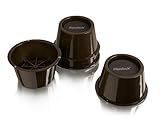
- Best budgetSlipstick CB654 3" Furniture Risers (4-pack)~$20
Then I bought a $40 RGB floor lamp on a whim, stuck it in the empty corner behind the couch, and the room changed more than it had in two years of half-hearted fixes. Not because of the colors — I'll get to why the colors are almost beside the point — but because of what one lamp in one corner does to a room after dark. This is the case for it, plus the handful of cheap things that make the corner around it look intentional instead of like a college dorm with a mood ring.
Why one overhead light was ruining every evening
Overhead light is efficient and it is nobody's friend. A single ceiling fixture throws light straight down, which flattens faces, erases shadow, and lights the whole room to the same flat brightness whether you're hosting people or trying to wind down alone with a book. There's no gradient, no warmth, no sense that the room has depth. It's the lighting equivalent of shouting at a normal conversational volume — technically it works, but it's exhausting in a way you don't register until it's gone.
Interior designers have known this forever and just don't say it in a way that sticks: a room needs layered light, not one strong source. That means something up high for general visibility, and at least one source down low, at eye level or below, that creates shadow and contrast. A corner floor lamp does exactly that job, and it does it from the one spot most living rooms struggle to light — the corner. Corners are naturally darker than the center of a room, so a lamp there does double duty: it fills a dead zone and adds the vertical variation that makes a room look considered instead of just illuminated.
The lamp that actually did it
I didn't research this purchase. I saw a corner-shaped RGB floor lamp recommended in a "small apartment lighting" thread, it was $40, and I figured worst case it becomes a nightlight I regret. It did not become a regret. The Govee Corner Floor Lamp is a tall, slim LED panel shaped to sit flush in a 90-degree corner, which matters more than it sounds — a normal lamp in a corner still has a base sticking into the room, while this one disappears into the angle and reads as part of the wall, not furniture.
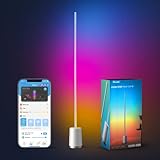
The part that actually fixed the room wasn't the RGB novelty — it was that this became our low, warm, evening light source, replacing the overhead fixture entirely after about 7pm. Suddenly the room had a "daytime mode" and a "nighttime mode," and the nighttime mode looked like somewhere I wanted to sit down. That's the whole trick: a second, lower, gentler light source that exists so you never have to flip on the harsh one after dark again.
What to actually set it to instead of the default rainbow cycle
Here's the part nobody tells you before you buy one of these: the default settings are bad, and if you leave it on the factory rainbow cycle, you will get sick of it in about four days and the lamp will quietly become the thing you never turn on. The default modes exist to look impressive in a five-second demo video, not to live with every night. Skip almost all of them.
What actually works long-term is embarrassingly boring: a single warm amber tone, dimmed to maybe 30–40% brightness, with the color-cycling and music-sync modes turned off entirely. Most of these lamps' apps let you save that as a custom scene, one tap away instead of scrolling past twelve strobing options every time. For movie nights, a deep warm orange or soft rose works well — dim enough not to compete with the TV, warm enough that the room doesn't go cold and blue the way overhead light does. Save two or three scenes you actually like and leave the built-in "party" modes alone. The lamp's job is ambience, not a light show.
The other setting worth knowing about: most of these lamps let you segment the color zones or set a gradient instead of one flat color. A gradient from warm amber at the bottom to a slightly cooler warm white at the top reads like a designed light fixture instead of a gaming setup — a small setting, buried two menus deep, that makes a real difference.
Building the corner around it
A lamp glowing in an otherwise bare corner still looks unfinished, so once ours was working the way I wanted, I spent about $110 more making that corner look like it belonged together instead of like an accent light someone forgot to build a room around.
First problem: the cord ran straight across the floor behind our media console to the nearest outlet, which is the fastest way to make a nice light source look like a tripping hazard. A cable management box hides the excess cord and the power strip it plugs into, so all you see is one clean line running up to the lamp.
Second problem: the media console sat too flush to the floor for the lamp's glow to wrap around it — the light was hitting the wall behind it instead of the surface where we actually look. Furniture risers lifted it three inches, and light suddenly traveled around it instead of stopping short. It adds storage space underneath too, a nice side effect for a $20 fix.
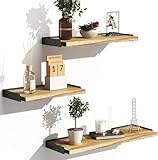
Third: the wall space above the console was empty, and empty wall next to a glowing corner just draws attention to how empty it is. Floating shelves gave us somewhere to put a few plants and books, and — the part that actually mattered for the lighting — a surface for the lamp's glow to catch and bounce off. Light hitting a bare wall looks flat. Light hitting shelves with texture on them looks like it's doing something.
Last thing, and this one surprised me: our old sheer curtains let in enough streetlight that the lamp's warm glow was constantly fighting a cooler light source from the window, and the clash made the room look unsettled instead of cozy. Blackout curtains solved a problem I didn't know I had — once the window light was gone, the lamp became the only color temperature in the room, and everything read as intentional instead of accidental. It's also just a better setup for actual movie nights, the whole point of the exercise.
What to skip
Skip the $12 RGB LED strips you see everywhere. I owned a set before the lamp, stuck behind the TV, and within about four months the colors had visibly drifted — a "white" setting showing a faint sickly green instead, because cheap strips use inconsistent diodes that age at different rates. On a strip with hundreds of tiny LEDs, that desync is basically inevitable within a year, and there's no fixing it — you replace the whole strip. A single lamp with a handful of larger, matched LEDs doesn't have that problem, and it's a better use of $40 than $12 spent twice.
Also skip relying on overhead light as your only source, even if you never buy a colored bulb. The fix isn't specifically "buy RGB" — it's "add a second, lower light source so the room has more than one mode." RGB is a bonus on top of that, not the reason it works. A corner lamp in plain warm white still fixes 90% of the problem.
One more: don't buy the color-changing lamp expecting to use the color-changing part often. For most living rooms, the value is in one or two saved warm scenes you use constantly, not the 16 million colors you'll open the app for twice and never touch again.
Frequently asked questions
Do corner floor lamps actually make a room look bigger?
Indirectly, yes. Corners are usually the darkest, most ignored part of a room, and lighting them draws the eye toward the edges of the space instead of leaving it concentrated under an overhead fixture. A room lit corner-to-corner reads as larger than the same room lit only from above.
What color should I actually set an RGB lamp to for everyday use?
A warm amber or soft white, dimmed to roughly 30–40% brightness, saved as a custom scene. Skip the default rainbow cycle and music-sync modes — they're fun for about a week and then become the reason people stop turning the lamp on. Save two or three warm scenes and rotate between those instead.
Do cheap RGB LED strips actually go bad, or is that overstated?
They do. Budget strips use inconsistent diodes that age unevenly, so within 6–12 months you'll often see visible color drift — a "white" setting turned slightly green or pink on part of the strip. It's not fixable; the diodes have simply aged differently. A single lamp with fewer, better-matched LEDs holds its color much longer.
Is one floor lamp enough to replace overhead lighting, or do I need more?
One well-placed lamp fixes most of the problem in a room that size, especially in a corner that was previously dark. For larger rooms, or ones used for several things, a second low light source on the opposite side helps avoid harsh shadows from a single point of light.
Does hiding the lamp's cord actually matter, or is that just tidiness?
It matters more for how "finished" the setup looks than for function. A glowing lamp with a cord snaking to an outlet reads as temporary no matter how nice the light itself looks. A cable box makes the same lamp look planned rather than improvised.
Will furniture risers actually make a visible difference with lighting?
Yes, more than expected. Furniture sitting flush on the floor blocks light from traveling under and around it, so a lamp's glow tends to hit a wall and stop. Even 3 inches of clearance lets light wrap around console tables and cabinets instead of just lighting the wall behind them.