Small apartments have a specific kind of clutter problem: it's not that you have too much stuff, it's that you have a completely normal amount of stuff and nowhere to put it that doesn't look like a dorm room. Stackable plastic bins from the drugstore. A rolling cart wedged behind the couch. Command hooks holding a nest of extension cords. It all technically works. It also makes a 550-square-foot apartment look like it's mid-move, permanently.
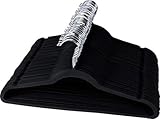
- Top pickUtopia Home Velvet Hangers (50-pack)~$18 for 50
- Best budgetOXO Good Grips POP Container (3.4qt)~$16 each
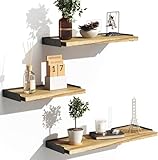
- Worth the splurgeBayka Floating Shelves (Set of 3)~$36 for set of 3
The good news is that storage and styling aren't actually in tension. The products that solve real storage problems — the ones professional organizers and small-space renters actually swear by — mostly look intentional by design, not despite it. You just have to skip the stuff engineered for a big-box endcap and buy the stuff engineered for apartments people actually live in. Here's what's worth buying, and what to walk right past.
The one closet swap that changes everything
If you do exactly one thing on this list, make it this. Swap every hanger in your closet — wire, mismatched plastic, the free ones from the dry cleaner — for a single matching set of thin velvet hangers. It sounds cosmetic. It isn't. Velvet hangers are a fraction of the width of standard plastic ones, so the same closet rod that used to hold 40 shirts now holds 60. Clothes stop sliding off the shoulders, which means fewer things end up in a pile on the floor because they fell off a hanger three days ago and nobody noticed. And because every hanger matches, the closet reads as curated the second you open the door — even if what's hanging on it is half gym clothes. It's the best ratio of effort to visible change of anything here.
The junk drawer isn't the problem — the wrong organizer is
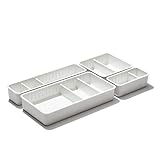
Every apartment has one drawer that's become a landfill for batteries, rubber bands, a single AirPod, and three takeout menus nobody's ordered from in years. The instinct is to buy a bin and hope. What actually works is an interlocking organizer with no fixed compartments, so it reconfigures to whatever oddly-shaped stuff you own instead of forcing your stuff into a mold designed for someone else's kitchen. Twenty minutes, and the drawer stops being a place you avoid opening in front of guests.
The same logic applies to your pantry shelf or cabinet, which in a small kitchen is usually a chaos of half-open bags clipped shut with binder clips. Clear, stackable containers with a one-touch seal do two things at once: they keep flour and cereal actually fresh, and they turn a shelf of mismatched packaging into something that looks like it belongs in a magazine photo. You're not really buying storage here — you're buying uniformity, and uniformity is most of what "looks organized" means to the eye.

Your walls are storage you're already paying for
In a small apartment, floor space is the scarcest resource you have, and most storage furniture — a bookshelf, a sideboard, a storage ottoman — eats floor space to give you storage. Floating shelves flip that trade entirely. They mount to the wall, add real usable storage, and cost you zero square feet on the floor. A set of three, staggered at different heights instead of lined up in a row, reads as intentional styling — the kind of thing you'd see in a design magazine — while quietly holding books, plants, or bathroom essentials that would otherwise be crowding a countertop. This is about as close as you'll get to an actual product category for "storage that disguises itself as decor," and it's worth leaning on hard in a studio or one-bedroom.
Under your bed is prime real estate, not a dust graveyard
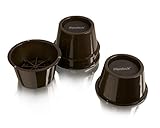
The space under a standard bed frame holds two to three cubic feet of usable storage, and in most apartments it's either completely empty or home to one sad, dusty duffel bag. Two products make that space genuinely functional instead of an afterthought. First: vacuum storage bags, which compress bulky items — winter coats, extra bedding, off-season clothes — down to a fraction of their original size, so what used to be an overstuffed bag becomes something that slides flat under the bed frame with room to spare. Second: furniture risers, which lift your bed (or couch, or dresser) three to five inches off the ground, instantly converting a gap that was too shallow to use into one that fits real storage bins. Combined, these two things can free up the equivalent of a small closet without buying a single new piece of furniture.
The stuff that can't look pretty, so hide it instead
Not everything can be styled. Power strips, router cables, the charging-brick situation behind your desk — none of that is ever going to look intentional no matter how you arrange it, so the better move is to stop trying and hide it completely. A ventilated cable management box swallows a power strip and its accompanying nest of cords, leaving only the one or two cables that actually need to stay visible. It's a five-minute fix for a problem that's been quietly bothering you for over a year.
The same hide-it-don't-style-it logic works at a bigger scale. If you've got open shelving, a wire rack, or a storage nook holding genuinely unglamorous stuff — cleaning supplies, off-season gear, the box of cords you're not ready to throw away — a simple curtain hung on a tension rod in front of it does more for a room's appearance than any bin ever will. It's the trick stylists use to make a studio apartment look finished on camera: you don't organize the mess, you put a curtain in front of it.
What to skip
A few categories get marketed hard as "small-space solutions" and mostly aren't. Skip over-the-door shoe organizers with dozens of tiny clear pockets — they hold a lot in theory, but in practice they turn your door into a wall of visible clutter every time you walk past it, which defeats the entire point of this list. Skip decorative wicker baskets that don't stack or nest; they look nice as a single accent piece but multiply fast and eat floor space exactly like the furniture you were trying to avoid in the first place. And skip any "multi-tiered rolling cart" that isn't parked near a kitchen or craft space — genuinely useful in the right room, but in a living room it reads as exactly what it is: a cart. If a product's main selling point is how much it can hold rather than how it looks holding it, that's usually the tell that it belongs in a garage, not an apartment you're trying to make feel finished.
The real principle behind all of this
Storage that doesn't look like storage almost always comes down to three things: matching (hangers, containers, and bins in one finish instead of five), verticality (walls and under-bed space instead of floor-eating furniture), and concealment (curtains and boxes for the stuff that will never look good no matter what you do to it). You don't need to buy everything on this list at once. Start with the hangers — cheapest, fastest, biggest visible change — and work your way down based on whichever room in your apartment is bothering you the most right now.
Frequently asked questions
What's the single best first purchase for small apartment storage?
Velvet hangers. They cost under $20, take twenty minutes to swap in, and immediately free up closet rod space while making the closet look uniform and intentional. Nothing else on this list changes as much for as little effort.
Do floating shelves actually hold real weight, or are they just decorative?
Quality floating shelves like the Bayka set hold up to 33 lbs each when installed into wall studs with the included hardware. That's enough for books, small plants, folded towels, or kitchen items — genuinely functional storage, not just a display ledge.
Are vacuum storage bags worth it for a small apartment?
Yes, specifically for seasonal or infrequently-used items — winter coats, extra bedding, holiday linens. They're less useful for things you need weekly access to, since resealing them each time is a hassle. For under-bed or top-of-closet storage of seasonal items, they're excellent.
How do I organize a small apartment without buying a bunch of matching bins?
You don't need a full matching system to see a difference. Start with the highest-visibility areas — hangers in the closet, one drawer, one shelf — and let uniformity spread from there as you replace things naturally. A fully matched system looks nice, but a 70%-matched system still reads as organized.
What's the best way to hide clutter I can't get rid of?
A tension-rod curtain in front of open shelving or a storage nook is the fastest, cheapest option — it fully conceals whatever's behind it for about $30. For smaller messes like cables and power strips, a ventilated cable management box does the same job at desk scale.
Are furniture risers safe to use on a bed frame?
Yes, as long as you buy risers rated for the combined weight of the furniture plus its contents — most quality sets like Slipstick are rated well over 1,000 lbs total across a set of four. Make sure the riser cup matches your leg shape (round or square) so the furniture sits securely and doesn't wobble.