Cheap chargers and cables fail fast — frayed jackets, slow charging, power banks that die mid-flight with zero warning. Every household has a drawer that proves it: a tangle of white cables with the rubber peeling back near the connector, three wall bricks that only sort of charge your phone, and one mystery cord nobody remembers buying. It's a graveyard of good intentions and bad five-dollar decisions.
Here's the pattern nobody names out loud. You buy the cheap cable. It frays in six weeks. You buy another cheap cable because surely that one was just unlucky. It frays too. Eventually — usually while you're already annoyed, standing in a store, phone at 8% — you buy the good one. You've now paid for three cables to get one that actually works. That's buying twice, sometimes three times, and it's the single most avoidable tax in home electronics.
This isn't an argument for buying everything expensive — that's its own kind of waste. It's about knowing exactly which categories punish cheapness immediately, and which ones genuinely don't care.
Why your cheap cable dies in six weeks
It's worth understanding the actual mechanism, because once you see it, you can't unsee it in every gas-station charging cable you've ever owned. A cable is just wire wrapped in insulation, and the cheap ones cut corners in two specific places: the gauge of copper inside, and the strain relief where the cable meets the connector.
Thinner copper can technically carry current, but it heats up more doing it and degrades faster under repeated bending. Combine that with a connector that's molded on with minimal reinforcement, and you get a cable that fails exactly where you'd expect — right at the joint, from the thousands of times it gets bent there every time you plug your phone in at a weird angle on the nightstand. That's the fray you notice first: the outer jacket splitting a half-inch from the connector, then a wire poking through, then a cable that only charges if you hold it at a specific angle like you're defusing a bomb.
The charging side has its own version of the same problem. A lot of bargain wall chargers and cables are labeled "fast charging" but aren't actually rated to deliver the wattage that implies. Your phone requests 20 or 25 watts, the charger can't actually supply it, and you get a slow trickle instead — a charger that technically works but leaves your phone at 40% when you wanted to walk out the door at 100%. You bought a fast charger. You own a slow one. Nobody told you the difference.
The buy-it-twice tax, explained
Do the math honestly. An $8 cable that lasts six weeks, replaced three times over a year, costs you $24 and three separate trips to buy a replacement you'll inevitably forget until your phone is at 2% and you're already late. A single $16-20 braided cable, bought once, outlasts all three of those combined — and you're never standing in a checkout line irritated on a random Tuesday because a cord failed you again.
That's the whole argument. "Buying twice" isn't really about spending more money — it's about spending it in the wrong order. You're paying the good-cable price eventually anyway; the only question is whether you pay it after two failures and a mildly ruined afternoon, or once, up front, and then never think about it again. Cheap-first feels frugal in the moment and turns out to be the more expensive path almost every time you actually track it.
Worth the money: power banks, wall chargers, and hubs that deliver what they promise
This is the category where cheap really does cost you real capability, not just durability. A power bank that claims 20,000mAh but uses low-grade cells will deliver noticeably less usable capacity, charge more slowly, and lose meaningful capacity after a few hundred charge cycles. A wall charger that isn't genuinely rated for USB Power Delivery won't fast-charge a modern phone or laptop no matter what the box art promises — you're paying for a sticker, not a spec.
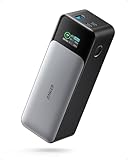
The Anker 737 PowerCore 24K is the kind of power bank worth the extra money. It's rated for real 140W output — enough to fast-charge a laptop, not just top off a phone — and it has a built-in display that shows remaining capacity and live wattage instead of four vague LED dots you have to guess at. If you've ever had a power bank die on you mid-flight with zero warning, a real charge readout alone is worth the upgrade.
Wall chargers deserve the same scrutiny. Look specifically for GaN (gallium nitride) chargers — they run cooler, pack more wattage into a smaller brick, and are almost always made by brands that actually publish real certification data instead of hiding behind vague "fast charge" language. A genuine 65-100W GaN charger can charge a laptop and a phone off the same brick, which quietly eliminates half the wall-wart clutter in most homes. The same logic applies to multi-port USB hubs: a cheap hub with unmarked ports will bottleneck every device plugged into it to the slowest common denominator, while a properly rated hub delivers full power independently to each port. If you're charging more than one device from a single outlet — which, let's be honest, is basically everyone now — this is not the place to save four dollars.
Worth the money: braided, correctly-rated cables
Cables are where people most often assume "a cable is a cable." It isn't. Two USB-C cables can look identical and still be wildly different products — one rated for 60W USB Power Delivery with real data-transfer speeds, the other capped at 15W with no data lines at all, sold at nearly the same price in nearly identical packaging.
Braided nylon cables are worth the few extra dollars for one specific reason: they solve the exact failure point described above. A braided sleeve distributes bend stress across the whole cable instead of concentrating it at the connector joint, so the fray-at-the-tip failure that kills cheap rubber cables essentially doesn't happen to a well-made braided one. Look for cables explicitly rated for the wattage you actually need — 60W is plenty for phones and tablets, 100W if you're charging a laptop off it — and reinforced connector housings, usually visible as a slightly thicker, often metal-capped tip. A quality 100W braided USB-C cable from a known brand runs about $15-20 and will outlast four bargain-bin cables bought over the same span.
Where cheap is genuinely fine (and keeping the good stuff from turning into chaos again)
Not everything in this category deserves the upgrade treatment, and pretending otherwise is how people end up with an $800 desk setup and a still-messy desk. A basic USB-A cable for a mouse, a keyboard, or anything charging at low, unhurried wattage doesn't need to be braided or fast-rated — it's barely being asked to do anything. A spare cable that lives permanently in a car glovebox, a gym bag, or a junk drawer for emergencies is a fine place to use the cheap one, precisely because it isn't getting bent and unbent daily. Buy quality for the cables and chargers in daily rotation; buy whatever's cheapest for the ones that exist purely as backup.
The other half of this problem has nothing to do with quality and everything to do with entropy. Even good cables turn into a nest if there's nowhere for them to live. Once you've actually upgraded the two or three chargers and cables you touch every day, the fastest way to keep that win from unraveling is to give the power strip and its cord tangle somewhere to disappear to. A ventilated cable management box hides the power strip and the slack cable behind a clean front panel — cords exit cleanly through side slots, the lid stays shut, and the visual chaos that made your desk or entertainment center feel stressful just stops being visible. It's a genuinely boring product that solves a problem you stopped consciously noticing but never stopped feeling.
What to skip entirely
A few categories are worth naming directly, because they're where money quietly disappears into stuff that fails fast and sometimes takes a device down with it.
Bargain-bin multi-packs of charging cables — the ones sold five-for-ten-dollars with no visible brand name — are built to the absolute minimum spec that still technically charges a phone in a store demo. They're not rated for the wattage they imply, the copper gauge is thin, and the strain relief is close to nonexistent. They're fine as glovebox backups. They are not fine as your only cable.
Off-brand "fast chargers" are the riskiest item on this list, not just the most annoying. A wall charger with no real safety certification can deliver inconsistent voltage, which in the worst cases damages the battery it's charging or, rarely, becomes a fire risk. This is the one category where "it probably still works fine" isn't good enough — look for UL certification or an equivalent safety mark, and buy from a brand that actually publishes real wattage specs instead of marketing copy.
Generic "USB-C to everything" dongles — the ones that promise HDMI, Ethernet, SD card, and three USB ports off a single unmarked chip — are notorious for dropping connections, overheating under sustained use, and bottlenecking data speeds far below what any single port could do alone. If you genuinely need a hub, buy one from a brand that lists which chipset it uses and what each port is actually rated for. If you just need an occasional one-off adapter, the cheap version is a defensible risk — just don't expect it to survive daily use.
Frequently asked questions
What's actually worth spending more on: cables or chargers?
Both, but for different reasons. Chargers and power banks fail on capability — a cheap one may never deliver the wattage it claims. Cables fail on durability — they physically wear out at the connector joint. Spend on whichever one you touch every day; skip the upgrade on anything that's just a backup.
How do I know if a cable is actually rated for fast charging?
Check the listed wattage or amperage in the product specs, not just the words "fast charging" in the title. A cable genuinely capable of fast-charging a phone should specify 60W (3A/20V) USB Power Delivery or higher; laptop charging needs 100W. If a listing doesn't mention a wattage number at all, assume it's not rated for it.
Are braided cables actually more durable, or is that just marketing?
It's real. The braided sleeve distributes bending stress across the length of the cable instead of concentrating it at the connector joint, which is where cheap rubber-jacketed cables almost always fail first. It's one of the few "premium" cable features that maps to an actual mechanical difference.
Is it safe to use an off-brand fast charger?
Not reliably. Chargers without real safety certification (look for UL or an equivalent mark) can deliver inconsistent voltage, which can degrade a battery faster or, in rare cases, pose a fire risk. This is the one category on this list worth being genuinely cautious about, not just quality-conscious.
Do I need a 100W cable if I'm only charging a phone?
No. Most phones and tablets top out around 20-30W, so a 60W-rated cable already has plenty of headroom. Save the 100W braided cables for anything that charges a laptop, and use a lighter cable for phones — it's not wasted money, just unnecessary for that specific job.
What's the single best upgrade if I can only buy one thing?
The cable you use every single day — usually the one on your nightstand or in your bag. It's the one that gets bent the most and fails first. A $16-20 braided, correctly-rated cable there will outlast several cheap replacements and pay for itself within the first year.