Open pretty much any "best travel pillow" roundup and you'll notice something they all have in common: every pick assumes you're going to fall asleep sitting bolt upright, chin tucked, spine roughly vertical. That's a real way some people sleep on a plane. It is not how most people sleep, ever, in any context. If you're someone who sleeps on your side at home — head tilted, weight on your ear and cheek, not your chin — those guides were never actually written for you. This one is.
- Top pickBCOZZY Chin Supporting Travel Pillow~$35
- Best budgetMLVOC Travel Pillow 100% Pure Memory Foam~$26
- Worth the splurgeTravelrest Nest Ultimate Memory Foam Wrap Pillow~$50
Every travel pillow guide assumes you sleep bolt upright
Here's the thing nobody selling you a $40 neck pillow says out loud: almost all the engineering in this category targets one failure mode — your head falling forward when you doze off sitting up. That's a real problem for back sleepers, and there are genuinely clever fixes for it: braces that catch the chin, wraps that stop the forward nod. But if your natural position is on your side, forward chin-drop was never your problem. Yours is lateral — your head tips toward the window or your neighbor's shoulder, nothing catches it, and you wake up with a crick that lasts into the afternoon. Different failure mode, different fix, and almost nobody selling travel pillows says so.
A pillow that's excellent for a back sleeper can be actively useless for someone who sleeps on their side. Buying on star ratings alone, without checking whether the design matches your actual sleep position, is how so many travel pillows end up shoved in a seat-back pocket by hour two.
Skip the U-shape — it was built for the wrong problem
The classic horseshoe-shaped pillow is the default airport-kiosk purchase, and it's one of the worst-suited designs for a side sleeper specifically. It supports the sides of your neck when your head is centered and upright. The moment your head tips sideways — which is what side sleepers do the instant they relax — the soft foam on that side compresses flat under the real weight of your skull, with nothing structural underneath to stop the collapse. You end up with your ear jammed into your shoulder and the pillow doing basically nothing. The inflatable versions are worse: they squish under sustained lateral pressure right when you're finally tired enough to need them.
None of this makes the U-shape a bad product — it does what it was built to do for the sleep position it was built for. It just wasn't built for yours. A couple other categories are worth skipping for the same reason: microbead pillows, which feel novel but flatten under real head weight within minutes, and "4-in-1" pillows loaded with an eye mask or hood, where the extras add bulk without adding a single degree of actual support. If a pillow's main selling point has nothing to do with holding your head at an angle, it isn't solving your actual problem.
What actually helps: chin-and-cheek support, not neck support
The pillows that genuinely work for side sleeping share a different design logic. Instead of propping up the sides of your neck, they cradle your jaw and cheek and hold your head at a fixed angle, so the weight rests on structured foam instead of your own neck muscles. That's what actually prevents the wake-up-with-a-crick problem — not softness, but a shape that intercepts your head before it fully tips over.
The BCOZZY's whole premise: you shouldn't have to pick a side in advance. Regular chin-brace pillows (the Trtl included) support one side at a time — roll the other way in your sleep and you're on your own. The BCOZZY's symmetric wrap doesn't care which way you lean, a better match for anyone who shifts position mid-flight — most people, most flights.
If you always get the window seat: the J-pillow's real use case
The J-shaped pillow looks strange in photos — a long foam arm curling down from the neck support to rest against your collarbone — and it gets recommended constantly without anyone explaining what it's actually for. The honest version: it's built for one scenario, a window-seat side sleeper leaning their head against the window with the long arm bracing their shoulder and collarbone so the head doesn't slide down as they relax. In that setup, it works genuinely well — better than almost anything else here — because it's solving the exact lateral-collapse problem side sleepers have.
Outside that setup, it falls apart fast — in a middle or aisle seat, there's nothing for the long arm to lean against, so it just dangles. If you book windows because you like to lean and doze against the glass, this is worth owning. If you fly aisles or middles more often than not, skip it; you'd be paying for a feature you can't use.
If you switch positions mid-flight (most of us do)
Realistically, very few people sleep in one position for an entire flight — you start upright, drift sideways, wake up, drift the other way. A pillow built around only one failure mode, forward drop or lateral collapse, is going to leave gaps. The options below are the closest to real hybrids: sturdy enough to help with side-leaning, structured enough to still catch a forward chin-drop.
The Trtl's one real limitation here is that it's directional — you pick which shoulder it braces before putting it on, and switching sides mid-flight means taking it off and rewrapping. Worth knowing going in, since reviewers expecting it to work symmetrically like the BCOZZY sometimes come away disappointed for the wrong reason.
The one thing to pack next to your pillow
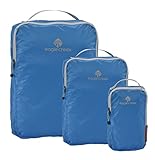
Every pillow here is bulkier than the flat inflatable ring you're used to shoving in a side pocket — that's kind of the point, since the ones that actually work have real structure. The tradeoff is carry-on space, which is exactly the space you also need for the rest of your kit. Compression cubes solve that math, freeing up enough room to bring an actual pillow instead of settling for whatever's cheapest at the gate.
Frequently asked questions
Is there really a difference between pillows for side sleepers and back sleepers?
Yes, and it comes down to which direction the pillow resists. Back and upright sleepers mainly need something to stop the head from dropping forward — a chin/front-brace problem. Side sleepers need something to stop the head from tipping laterally — a jaw/cheek-cradle problem. A pillow optimized for one doesn't automatically solve the other, which is why the same "best travel pillow" pick doesn't work for everyone.
Why is the classic U-shaped pillow so popular if it doesn't work well for side sleepers?
Mostly inertia and gift-shop availability — it's the shape people are used to seeing, and it does help keep an upright, centered head from wobbling slightly. It just doesn't have the structural resistance to hold real head weight once you tip into a side-sleeping position, which is the exact moment side sleepers need help most.
Should I get a window seat if I'm a side sleeper who travels with a neck pillow?
If you can, yes. A window gives you a second surface to lean into, and pillows like the J-Pillow are designed around that setup. Middle and aisle seats remove that option, which is when a symmetric wrap like the BCOZZY or a flexible option like the Travelrest Nest becomes more useful than a directional one.
How do I clean a memory foam travel pillow?
Almost all have a removable, machine-washable cover — wash that on cold and air dry. The foam core itself should never go in a washer or dryer; spot-clean with a damp cloth and mild soap, then air dry fully before the cover goes back on, or the foam's structure breaks down and stops springing back.
Is it worth spending $35–50 on a travel pillow instead of $10?
If you fly more than a couple times a year and actually want to sleep, yes. The cheap options fail in the exact way side sleepers need help most — they collapse under lateral weight. The pillows worth buying here are dense or structured enough to hold that weight, which is what separates a $10 pillow from a $35 one.
Can side sleepers use the Trtl or Cabeau, or do they need a dedicated design?
Both can work, with caveats. The Cabeau Evolution S3's reinforced side walls give real lateral resistance, a solid hybrid pick. The Trtl works well for the one side it's wrapped to support, but you have to commit to a direction, unlike a symmetric option like the BCOZZY that works no matter which way you lean.