Here is the thing about cheap travel crates: they are fine until they aren't, and the moment they aren't is usually 37,000 feet in the air, or at a cargo check-in counter, or three hours into a road trip when your dog has stress-chewed through the door latch. A travel crate is one of the few pieces of pet gear where the quality difference between a $60 Amazon special and a $250 real one is measured in safety, not aesthetics. This guide covers the crates actually worth the money, what the airlines require, and the companion gear that makes the whole thing less stressful for both of you.
The three crates that actually hold up
I'll say upfront: none of the three best travel crates are available on Amazon with a standard affiliate link, which is annoying but also telling — the serious ones are sold direct because the buyers are serious. Here are the ones worth knowing about.
Petmate Sky Kennel is the workhorse of cargo travel. It's the crate you'll see at every airline cargo counter, at every dog show backstage area, and in the back of every serious rescue transport van. It's injection-molded polyethylene, holds up to a 125-pound dog in the largest configuration, meets IATA CR82 live animal regulations out of the box, and has been around long enough that every airline agent recognizes it. Runs about $45 for small sizes to $130 for the 48-inch. If your dog flies cargo more than once a year, this is the default answer.
Gunner G1 Intermediate is in a completely different category — a crash-tested, rotomolded crate designed for vehicles rather than airline cargo. If you drive with your dog and you want the thing that actually protects them in an accident, the Gunner is it. It's passed Center for Pet Safety certification, the hardware is stainless, and the handle is milled aluminum. It starts around $525 and that number makes people wince. Then they watch the crash test video and stop wincing. Not for every family, but for people who drive dogs long distances regularly, it's the correct answer.
Ruff Land Performance Kennel sits between the two in both price and purpose. It's rotomolded like the Gunner, so it's vastly more durable than the Petmate, but it comes in at roughly $180–$350 depending on size. It's what competitive dog sport people use — field trial folks, agility handlers, hunting dog owners — because it travels well in trucks, holds up to heavy use, and is light enough that one person can actually move it. If you want something tougher than a Petmate but less than a Gunner investment, Ruff Land is the move.
What the airlines actually require
This is the section most articles skim. The reality is that airline crate requirements are stricter than most people realize, and showing up with the wrong setup means your dog doesn't get on the plane. These rules apply whether your dog flies in cabin (under seat) or in cargo (checked or as air cargo).
For in-cabin travel, the crate must fit entirely under the seat in front of you — typically 18"L x 11"W x 11"H for most domestic airlines, though this varies. Soft-sided is usually acceptable here. The crate must be well-ventilated, leak-proof lined, and your dog must be able to stand, turn around, and lie down comfortably. Airlines also require that the pet remain in the carrier for the duration of the flight.
For cargo and checked baggage travel, IATA Container Requirement 82 (CR82) is the standard most airlines enforce. Key points:
- Hard-sided construction only. No soft-sided crates in cargo, ever.
- The crate must be large enough for the dog to stand at full height, turn completely around, and lie down in a natural position.
- Minimum ventilation: 16% of total wall surface area, on at least three sides.
- Doors must be secured with both bolts and cable ties (most airlines require 4 zip ties minimum). Zip ties through the door hardware, not just around the outside.
- A water/food dish must be attached inside and accessible from outside for hydration without opening the crate.
- "Live Animal" labels and directional arrows (this end up) are required on the outside.
- Absorbent bedding inside.
- Your contact info attached to the outside of the crate.
Individual airlines add requirements on top of IATA, especially temperature cutoffs. Delta, United, and American all restrict cargo pets when temperatures at origin, destination, or any connecting airport are projected to be above 85°F or below 45°F at any point in the routing. Check directly with your airline 72 hours before travel, not just when you book.

Crate training before you travel — it changes everything
The single highest-leverage thing you can do for a traveling dog isn't buying the right crate. It's making the crate a place your dog actually wants to be before the trip. A dog that has been crated-trained understands the crate as a den — safe, calm, theirs. A dog that's never been in a crate, then gets put in one in an airport cargo hold, is having a completely different experience.
The KONG Classic is the best crate training tool on the market. Stuff it with peanut butter (xylitol-free only — check the label) or plain cream cheese, freeze it overnight, and give it to your dog in the crate with the door closed. The chewing is calming, the licking is calming, and your dog associates the crate with the best thing in their day. Do this daily for 3–4 weeks before travel and you will have a meaningfully different dog on departure day.

Beyond KONG sessions, the training protocol that works: start with the crate door open and meals next to it, move meals to inside the crate (door still open), then start closing the door during meals for increasing durations, then do short crate sessions with a stuffed KONG during non-meal times, then work up to an hour. A dog that can sleep in a crate calmly for two hours at home will generally handle a 4-hour flight in cargo without any panic. A dog that's never done more than 20 minutes will have a harder time regardless of what crate you buy.
Packing your pet supplies for a trip
One organizational headache nobody warns you about: traveling with a dog means carrying a lot of small, awkward things. A leash, collar, harness, poop bags, food, treats, a travel bowl, a comb or brush, medications, vaccination records, and the various documentation your airline, hotel, or destination requires. It's easy for all of this to become a jumbled duffel situation where you spend five minutes excavating your bag at the park trying to find the poop bags.
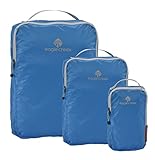
The best solution I've used is the Eagle Creek Pack-It Cube system, but repurposed for pet supplies instead of clothing. One medium cube for food and treats, one small cube for accessories (leash, collar, harness, bags), a toiletry bag for any medications or grooming supplies. Everything compresses, stacks, and loads into a carry-on or checked bag cleanly. When you arrive somewhere and need to repack to go to the dog park, you grab the right cube instead of the whole bag.

The overnight and multi-stop trip checklist
For road trips and multi-city travel, a bit of pre-trip organization makes the whole thing manageable. Here's what actually goes in each category:
Documentation envelope (keep on your person, not in checked bags): Vaccination records and/or health certificate (issued within 10 days of travel for most airlines), USDA endorsement if crossing state lines, your vet's contact information, your dog's microchip number written down, a recent photo of your dog in case of separation.
In the crate for cargo travel: Absorbent mat or bedding (an old t-shirt with your scent works well), a frozen KONG stuffed the night before, a spill-proof water dish clipped inside, your contact info on the door, "Live Animal" stickers, zip ties already through the hardware.
In your carry-on if flying cargo: Your dog's food in a sealed bag (airline may confiscate it if you check it), any medications with labels from the vet, a spare leash in case something happens to the primary.
In the hotel room: A familiar-smelling item (the t-shirt from the crate), the KONG for settling your dog while you unpack, a compact travel bowl for food and water. If your dog is crate trained, travel with a collapsible or soft crate so they have a consistent "room" at every stop — it makes hotels dramatically easier.
What to skip
A few things that are not worth your money in the travel-crate category. Soft-sided "travel kennels" that claim to be airline approved for cargo: they are not. Hard-sided crates on Amazon from no-name brands with plastic hardware: the latches fail. Sedating your dog with Benadryl for travel unless a vet has specifically recommended it for your individual dog: sedation actually increases the risk of respiratory distress in cargo. And those $20 clip-on water bottles that attach to the crate door: they drip and soak your dog's bedding. Get an actual airline-approved dish that mounts inside instead.
FAQs
What size crate does my dog need for air travel?
Your dog must be able to stand at full height without their head touching the top, turn completely around in a circle, and lie down in a natural position — not curled up tight, but actually stretched out. Measure your dog standing (floor to top of head), from nose to base of tail, and shoulder width. Add 4 inches to height and length, and 2 inches to width, to get the minimum interior crate dimensions. When in doubt, size up. Airlines may turn away a dog in a crate that's visibly too small.
Can my dog fly in the cabin with me?
It depends on size. Most airlines allow dogs in cabin if the carrier fits under the seat (typically pets under 20 lbs including carrier). The carrier must fit under the seat in front of you for the entire flight. Your dog must stay inside the carrier throughout. There's usually a fee ($95–$150 each way) and a limit on the number of pets per flight, so book early. Check your specific airline's policy, as they vary meaningfully.
Is cargo travel actually safe for dogs?
Statistically, yes — the vast majority of dogs travel by cargo without incident. The risks that exist are mostly tied to temperature extremes, brachycephalic (flat-faced) breeds who have breathing vulnerabilities, and dogs that are not crate trained and panic. Most incidents happen with breeds like bulldogs, pugs, and boxers, which is why many airlines restrict or ban them from cargo entirely. If your dog is a healthy breed, is crate trained, and you're traveling in moderate temperatures, cargo is generally safe.
How early should I get to the airport for a dog checked as cargo?
Plan for at least 90 minutes before your flight, and call ahead to confirm your airline's cargo check-in cutoff. Most require cargo pets to be checked in at least 2–3 hours before departure. The check-in counter for live animals is often separate from regular check-in. Arrive early, crate already set up with water dish, zip ties in place, and all documentation in hand.
Do I need a health certificate for domestic flights?
Most domestic US airlines require a health certificate issued by a licensed veterinarian within 10 days of travel. International travel requirements are more complex — you may need a USDA endorsement, specific vaccinations, parasite treatments, or even a waiting period. Start the international process at least 3–4 months out and contact the destination country's embassy or agriculture department directly, not just your vet.
Can I put anything in the crate with my dog?
Yes: absorbent bedding, a frozen stuffed KONG or other non-squeaky chew toy, and a spill-proof water dish attached inside. Keep it minimal — nothing that can become a hazard if your dog panics, and nothing that obstructs ventilation. A t-shirt or pillowcase with your scent is genuinely calming and weighs nothing. Do not put a collar with tags in the crate — if the collar snags on the door, it's a risk. Use a breakaway collar only, or none at all with a microchip as the primary ID.
What about road trips — do I need a crate in the car?
Legally, it depends on your state — a few have pet-restraint laws but most don't. From a safety standpoint: an unrestrained dog becomes a projectile in a crash, a risk to the driver when they move around, and a problem for first responders. A crash-tested crate like the Gunner G1 is the gold standard for vehicle safety. If that's not in the budget, a rear seat barrier and a crash-tested harness (look for Center for Pet Safety certification) is a reasonable middle ground.