Every kitchen has one: the sheet pan that used to lie flat and now rocks on the counter like a seesaw, the one that clangs and buckles the second it hits a hot oven, the one where your roasted vegetables slide into a puddle in the low corner while the high corner stays weirdly pale. You didn't do anything wrong. You bought a pan that was built to warp, and then you used it exactly the way the box told you to. The good news is that warping isn't a mystery or bad luck — it's physics, it's predictable, and it's almost entirely avoidable once you know what you're actually buying and how to treat it.
- Top pickSilpat Premium Non-Stick Baking Mat (Half Sheet)~$25
- Best budgetMicroplane Classic Zester/Grater~$15
- Worth the splurgeOXO Good Grips 17-Piece Stainless Steel Tool Set~$50
Why your $8 sheet pan buckles the first time you roast anything
Warping is what happens when metal heats unevenly and expands unevenly, and thin metal has almost no structural resistance to that expansion. Picture the pan as a flat plane under stress: the center heats up first and fastest, since it's surrounded by hot air on all sides, while the rim and corners lag slightly behind, still tethered to cooler air near the oven walls. In a heavy-gauge pan, that temperature gap is small enough that the metal just expands slightly and settles back down. In a thin, cheap pan, the gap is large enough that the center pops upward or the corners lift — the pan literally can't expand fast enough in a straight line, so it buckles into a curve instead, the same way a metal ruler bows if you push both ends toward each other.
The other half of the story is thermal shock, and this is the part almost nobody connects to warping until it's explained. You pull a screaming-hot pan out of a 425°F oven and set it directly on a wet countertop, or worse, run cold water over it in the sink because you want to get cleanup started. That sudden, extreme temperature swing on one side of the metal while the other side is still hot creates exactly the kind of uneven stress that causes permanent, irreversible warping — not gradual wear, but a single moment that changes the shape of the pan forever. Do that enough times to a thin pan and it never lies flat again, even once it cools back to room temperature.
Cheap pans are more vulnerable to both problems for the same underlying reason: thin gauge metal. Bakeware gauge is measured the opposite way you'd expect — a lower number means thicker, sturdier metal. Pans in the 22–26 gauge range (thin) are the ones that show up in bargain bins and dollar-store aisles, and they're the ones that warp within a handful of uses. Anything rated 18-gauge or heavier has enough mass to absorb heat more evenly and resist the kind of instant, dramatic expansion that causes buckling in the first place.
Aluminum vs. aluminized steel vs. stainless: what actually resists warping
Material matters almost as much as gauge, and the three you'll see over and over are aluminum, aluminized steel, and stainless steel — each with a real tradeoff, not a clear winner.
- Heavy-gauge aluminum is the standard in professional kitchens for a reason: it conducts heat fast and evenly, which is exactly what you want for browning and roasting. The catch is that pure aluminum is a relatively soft metal, so a thin aluminum pan warps faster than a thin steel one under the same heat. The fix isn't avoiding aluminum — it's buying it heavy-gauge, which is where restaurant-supply brands consistently outperform big-box store versions at a similar price.
- Aluminized steel — a steel core with an aluminum-alloy coating — is the sweet spot most serious bakeware settles on. It has steel's rigidity (steel resists bending far better than aluminum at the same thickness) plus aluminum's heat conductivity on the surface. This is the construction behind most of the commercial half-sheet pans that show up in professional bakeries and last for years of daily abuse.
- Stainless steel is the most warp-resistant of the three by a wide margin, but it's also the worst heat conductor of the group, which means more uneven browning and hot spots unless the pan has a thick aluminum or copper core sandwiched inside it. Plain stainless sheet pans are rare for this exact reason — you're trading away the thing sheet pans are supposed to be good at.
If you only remember one rule from this section: heavier is better, and "aluminized steel, 18-gauge or thicker" on the product description is the single strongest signal that a sheet pan will still be flat in five years.
Half sheet vs. quarter sheet: sizing actually changes the warp math
Size isn't just about how much food fits — it changes how the pan behaves under heat. A half sheet pan (roughly 18 x 13 inches) is the standard size that fits virtually every home oven and is what most commercial bakeware is built around, which means the good half-sheet pans get the most engineering attention and the widest selection of heavy-gauge options. A quarter sheet (roughly 13 x 9 inches) is genuinely useful for toasting nuts, reheating leftovers, or roasting a small side dish for one or two people, and — this is the part that surprises people — it's actually somewhat more warp-resistant per square inch than a half sheet, simply because it's a smaller plane of metal with less surface area to expand unevenly and less distance for that expansion to travel before it has to buckle.
The mistake people make is buying one giant sheet pan and cramming it edge-to-edge into an oven that barely clears it on either side, which traps heat against the oven walls and creates exactly the uneven heating pattern that stresses the metal. A half sheet with an inch or so of clearance on all sides performs better, warps less, and roasts more evenly than an oversized pan wedged in tight. If you're only going to own one size, own a half sheet. If you cook for one or two people regularly, a quarter sheet earns its cabinet space and will likely outlast the half sheet doing the same job with less stress on the metal.
The habits that keep a good pan flat for a decade
You can buy the right pan and still warp it in a year if you treat it the way most people treat bakeware by default. The habits that actually matter, in order of how much damage skipping them does:
- Never shock it with cold water or a wet counter. This is the single biggest cause of permanent warping and the easiest one to fix. Let a hot pan sit on a dry towel or a cooling rack for a few minutes before it touches anything cold or wet.
- Don't broil on a pan rated only for standard baking. Broiler heat is dramatically more intense and concentrated than a standard bake cycle, and pans not rated for it warp fast under that kind of direct, uneven exposure.
- Skip the metal utensils on coated pans. Scratching the surface doesn't cause warping directly, but it does compromise the coating that's supposed to protect the metal underneath, and a pan with peeling coating gets replaced anyway — so you lose it either way.
- Line it instead of spraying it directly, when you can. A liner distributes heat slightly more evenly across the surface and protects the pan's finish, which keeps the metal performing the way it did on day one for longer.
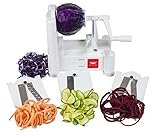
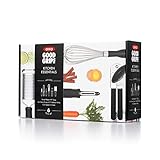
Nonstick coating vs. bare aluminum + parchment (or a mat)
This is where a lot of people overthink the decision. A nonstick-coated sheet pan gives you effortless release for delicate things — fish skin, meringues, anything with sugar that wants to caramelize onto the metal — but the coating is also the part that degrades fastest under high heat, metal utensils, and dishwasher cycles, which means a nonstick sheet pan has a shorter realistic lifespan than a bare one treated well. Bare aluminum or aluminized steel, on the other hand, is nearly indestructible as a material, but food sticks to it directly unless you put something between the two — parchment paper, foil, or a reusable silicone mat.
The honest answer is that the mat solves both problems at once: it gives you the nonstick release without a factory coating that wears out, and it protects bare metal from the direct contact that causes staining and stuck-on buildup over time — which, if you're using metal tools to scrape that buildup off, is its own slow contributor to warping and surface damage. This is the actual argument for owning a good silicone mat even if your pan is otherwise perfectly fine: it's cheaper over time than replacing a coated pan every couple of years, and it keeps the pan itself in better shape for longer.
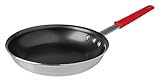
If you do want a factory nonstick coating — plenty of people prefer the convenience and don't mind eventual replacement — the same logic that makes heavy-gauge aluminum good for sheet pans applies to nonstick cookware generally. A pan like the Tramontina below uses the same heavy-gauge aluminum base under its coating, which is worth knowing even outside the sheet-pan category, since it's the same engineering tradeoff in a different shape.
What to skip, and the one alternative that physically cannot warp
Skip anything marketed with a thread-count-style number that doesn't map to anything real — "heavy duty" and "commercial grade" on the packaging mean nothing without a gauge number or material spec to back it up. Skip pans that already look slightly bowed in the store or in listing photos; a pan that arrives warped will not flatten itself out with use, and returning it is easier before it's covered in roasted chicken fat. Skip anything explicitly labeled disposable-adjacent — ultra-thin "value pack" pans sold in stacks of 3 or 4 for under $10 are built to be used a handful of times and thrown out, not to survive years of real cooking.
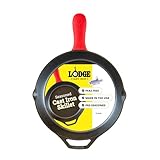
If warping genuinely offends you and you want one pan in the rotation that is structurally incapable of it, cast iron is the honest answer. It's heavy, it's not flat-sided the way a sheet pan is, and it's not a direct swap for a big batch of roasted vegetables — but for smaller jobs (a single sear-and-finish, a personal-size roast, bread that wants a hot surface to bake on) it holds its shape permanently, handles thermal shock far better than sheet metal, and will outlive every coated pan in the house.
Two prep tools worth pairing with good sheet pans
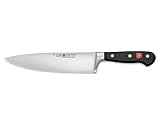
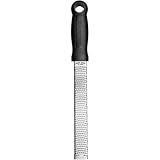
Neither of these touches the warping question directly, but both change how well a sheet pan performs day to day, which is really the point of buying a good one in the first place. Cutting vegetables into genuinely uniform pieces means the food roasts evenly across the whole tray instead of creating a scorched-and-raw split between thick and thin pieces — which also means you're not tempted to crank the oven hotter to compensate, one of the quieter ways people accidentally stress a pan over time. A sharp, properly weighted chef's knife makes uniform cuts easy instead of a chore.
None of this is complicated once you see the pattern. Buy heavier gauge than feels necessary, respect the temperature swing between oven and sink, keep metal utensils off anything coated, and put a mat or liner between food and bare metal. Do those four things and the pan you buy this year is the pan you'll still be using in 2032.
Frequently asked questions
Why do cheap sheet pans warp so quickly?
Two compounding factors: thin-gauge metal (usually 22–26 gauge on budget pans) that can't absorb heat evenly, and thermal shock from sudden temperature changes — like running cold water over a hot pan or setting it on a cold, wet counter straight from the oven. Thin metal expands unevenly under heat and has almost no structural rigidity to resist buckling when that happens. Heavier-gauge pans (18-gauge or thicker) have enough mass to expand more evenly and resist the same stress.
What's the actual difference between aluminum, aluminized steel, and stainless steel sheet pans?
Aluminum conducts heat fastest and browns food best but is a softer metal that warps more easily unless it's heavy-gauge. Aluminized steel — a steel core with an aluminum coating — combines steel's rigidity with aluminum's heat conductivity, and is what most durable commercial half-sheet pans are made from. Stainless steel resists warping best of the three but is a poor heat conductor on its own, leading to uneven browning unless it has a thick conductive core.
Should I buy a half sheet or a quarter sheet pan?
Half sheet (about 18 x 13 inches) is the standard size, fits most home ovens with clearance to spare, and has the widest selection of heavy-gauge options since it's the size professional bakeware is built around. Quarter sheet (about 13 x 9 inches) is genuinely useful for smaller batches — toasting nuts, reheating, cooking for one or two — and, as a smaller plane of metal, is somewhat more resistant to warping per square inch than a half sheet. Most kitchens benefit from owning one of each rather than only the larger size.
How do I keep a sheet pan from warping over time?
Never shock it with cold water or a cold, wet countertop straight out of a hot oven — let it cool on a dry towel or rack first. Avoid broiling on pans not rated for it. Use silicone or wood utensils instead of metal on anything coated. And line the pan with parchment or a reusable silicone mat rather than letting food and residue build up directly on bare metal.
Is a nonstick coating better than bare aluminum with parchment paper?
Neither is strictly better — they're different tradeoffs. A nonstick coating gives effortless release out of the box but degrades faster under high heat, metal utensils, and dishwasher use, shortening the pan's realistic lifespan. Bare aluminum or aluminized steel is nearly indestructible as a material but needs something between it and food — parchment, foil, or a reusable silicone mat — to prevent sticking and staining. A good silicone mat gets you the nonstick convenience without a coating that eventually wears out.
Can a warped sheet pan be fixed?
Not reliably, and not permanently. Some people try flipping the pan and pressing it flat, or reheating and cooling it under weight, but the metal has already been stressed in a way that tends to return once it's heated again. In practice, once a pan warps enough to rock on the counter or wobble in the oven, it's more realistic to replace it than to keep fighting the shape — which is exactly why buying the right gauge and material up front matters more than any after-the-fact fix.