Portable power stations used to be a niche prepper purchase. Then came the wildfire evacuations, the winter storm blackouts, and the camping trips where someone needed to charge a CPAP at 2am. Now they are the thing you want to have already bought when you need one. This guide cuts through inflated watt-hour numbers and solar-generator marketing.
How much capacity do you actually need?
Watt-hours (Wh) is the number that matters — it is energy, not power. Under 300Wh covers phones, laptops, and LED lights: fine for camping, useless for real emergencies. 300-700Wh adds a mini fridge for several hours or a CPAP. 700-1500Wh handles a full day of refrigeration or power tools on a job site. 1500Wh and up covers whole-household critical loads during extended outages. Most people under-buy by one tier — if you are buying for emergency prep, double your first instinct.
LFP vs NMC batteries — this matters more than brand name
Lithium Iron Phosphate (LFP) handles 2,000-3,500 cycles before degrading to 80% capacity. Thermally stable, tolerates full charges, charges well in cold. EcoFlow Delta 2, most Bluetti stations, and higher-end Jackery models use LFP. NMC is what most budget and mid-range stations use — 500-800 cycles, more heat-sensitive, degrades faster at 100% charge. For long-term emergency backup, LFP is worth the premium. For seasonal campers who expect to upgrade in a few years, NMC at a lower price point works fine.
Inverter watts explained
Brands advertise peak surge watts because the number is bigger. The continuous watt rating is what matters. Check the continuous wattage of everything you plan to plug in. A 1000W inverter runs a hair dryer barely — it will not run a 1500W heater. Pure sine wave output is required for laptops, medical devices, and newer TVs. If a station does not specify pure sine wave, skip it.
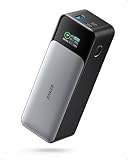
The Anker 737 PowerCore 24K: best high-capacity power bank
If you mostly need phone and laptop power on the go, the Anker 737 PowerCore 24K is the right tool — not a full power station. 24,000mAh, 140W output (charges a MacBook Pro at full speed), three devices simultaneously, built-in display showing wattage and battery percentage. No AC outlets, no solar input. For travel and commuting it beats any power station at this price.
Camping vs emergency prep vs job sites
Camping: 300-500Wh is usually enough for a weekend. Weight matters — you are loading it in and out of a car. If you run an electric cooler, step up to 500Wh. Solar panels pair well here since you are outside all day. Emergency backup: The realistic minimum is 1000Wh. A mid-size refrigerator draws 150W continuously — a 1000Wh station gives you about 5-6 hours of fridge time. The EcoFlow Delta 2 (1024Wh, LFP, 1800W inverter) is the one I'd recommend to most people. For medical equipment or sump pumps, go 2000Wh or above. Job sites: Require high continuous wattage (1500W minimum), rugged build, and fast AC recharging. The EcoFlow Delta 2 Max charges at 2400W, from 0 to 80% in under an hour.
What to skip under $100
Power stations under $100 have inflated capacity claims (actual usable Wh is 60-70% of the number), modified sine wave or poor-quality inverters, inadequate thermal management, and 8-12 hour charge times. The realistic minimum for a power station worth owning is about $200 for a basic camping unit and $600-800 for genuine emergency capability. Anything below that is a power bank with AC outlets bolted on.
How long will a 1000Wh station last during a power outage?
It depends on your load. 1000Wh times 0.85 (inverter efficiency) divided by your total watts gives your runtime in hours. At 200W total load (fridge plus lights plus phone charging) you get about 4-5 hours. At 30W (just charging phones) you get 28 hours. The fridge is almost always the load that limits your runtime.
Can I leave a power station plugged in all the time?
LFP stations are designed for always-on use. NMC stations degrade faster when kept at 100% charge continuously — keep them at 80% and top up monthly. Most stations let you set a maximum charge percentage in the app. EcoFlow and Bluetti LFP models explicitly support always-on backup operation.
Is Jackery or EcoFlow better?
Both are legitimate. EcoFlow pushes faster charging speeds and has a better app. Jackery has a longer track record and consistently strong warranty support. Bluetti is the third serious player, often offering LFP at lower price points than the other two. Buy based on specific model specs and price at your budget tier, not brand loyalty.
Do solar panels actually work for recharging?
Yes, with realistic expectations. A 100W panel in full summer sun delivers about 70-80W actual charging power. Charging a 1000Wh station from empty takes roughly 12-15 hours of good sun — about two days of camping weather. For meaningful solar charging, look for high solar input wattage (400W or more) on the station and plan to use 2-4 panels rather than one.
What is pure sine wave and why does it matter?
Sine wave refers to the shape of the AC power output. Pure sine wave matches what the grid delivers and is required for sensitive electronics — laptops, medical equipment, modern TVs. Modified sine wave is cheaper to produce and works for simple loads like incandescent bulbs, but can damage or interfere with sensitive devices. Every reputable power station now outputs pure sine wave. If a listing does not specify, it is likely modified sine wave — skip it.
Can a power station run a window air conditioner?
A 5,000 BTU window unit draws 450-500W running and spikes to 1200-1500W at startup. A 1000W continuous inverter will not handle the startup surge. A 2000W inverter station will, but you are burning through 500Wh per hour of runtime. Your 2000Wh station gives you 3-4 hours of cooling. For heat emergencies, a USB fan running at 10-20W for 50-100 hours is a more practical use of a power station than an AC unit.