Most rooms don't have a lighting problem. They have an overhead-only problem. That flat, shadowless light from a single ceiling fixture — especially when it's a cool-white LED — doesn't read as cozy. It reads as dentist office after hours. The fix isn't an expensive renovation. It's a floor lamp in the corner, a table lamp at eye level, and an understanding of why warm light hits different at 7pm.
- Top pickNICETOWN Blackout Curtains (2-Pack)~$30
- Worth the splurgeBenQ ScreenBar Monitor Light~$120
Kelvin temperature: the number that actually matters
Every light source has a color temperature measured in Kelvin. Lower = warmer, more amber. Higher = cooler, more clinical.
- 2700K–3000K: Warm white. Incandescent-adjacent. This is what good restaurant lighting looks like. Use it everywhere you want to relax.
- 3500K–4000K: Neutral white. Good for kitchens and bathrooms where you want clarity without harshness.
- 5000K–6500K: Cool/daylight white. Great for a desk or workshop. Terrible for a living room at 8pm.
Your overhead fixture is almost certainly running at 4000K or above. That's why it feels cold. The lamps you add should almost always be 2700K. This single change will do more for your room than any furniture rearrangement.
The case for layered lighting
Interior designers talk about lighting layers because it actually works. Ambient (general fill — your overhead), task (focused — desk lamp, reading lamp), and accent (decorative — floor lamp in a corner). A room with only ambient light feels flat and institutional. A room with all three layers feels finished, warm, and intentional.
In practice: keep the overhead dimmed or off in the evening, add a floor lamp in the far corner for depth, put a table lamp at sitting height near the sofa for reading. You're not adding more total lumens — you're distributing the light differently. That's what makes a room feel warm instead of bright.
This is also where blackout curtains come in — not just for sleep, but for light control. Blocking harsh outside ambient light in the evening lets your interior lamps do their job without competing.
Floor lamps: where to start
A floor lamp in the corner is the highest-leverage lighting move you can make. It creates uplight, fills a dead corner with visual interest, and gives you color temperature control. What to look for: a diffuser (frosted shade, not bare bulb), a dimmer switch, and a stable base.
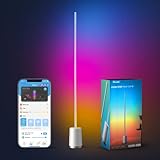
The Govee RGB floor lamp is the budget hero. At $40 it fits in corners by design, does a genuinely good warm white at 2700K, and the RGB modes are more useful than you'd expect. Smart-home compatible, so you can set schedules and automate the warm-to-cool transition at sunset.
Desk lamps: the task-lighting tier
For desk work, a cooler temperature (3500–4000K) actually makes sense — you're trying to see clearly, not relax. The BenQ ScreenBar solves the desk lighting problem more elegantly than any traditional lamp: it clips to your monitor, lights the desk without shining in your eyes or creating screen glare, and has a built-in ambient sensor that auto-adjusts brightness.

Smart bulbs vs. dimmable lamps
Two routes to tunable lighting: buy a smart bulb and put it in any lamp, or buy a lamp with controls built in. Smart bulbs are more flexible — you can upgrade any existing lamp, set schedules, use voice control. Built-in controls (like the Govee floor lamp) are simpler and cheaper if you're starting from scratch.
One practical note: smart bulbs need to stay powered on to receive signals. If someone flips the physical switch off, you lose control until it's manually switched back. For a floor lamp that lives in a corner you never physically switch, smart bulbs work seamlessly.
Wattage: for a standard floor lamp, 60W-equivalent LED (about 800 lumens) is right for ambient light. For reading, at least 100W-equivalent (1600 lumens) directed at the page. For accent lamps, 40W-equivalent is plenty.
A wall-mounted floating shelf near the sofa can supplement what a lamp can't do — small display items, a lamp base, the remote that always gets lost.

What to skip
Torchiere lamps with bare halogen bulbs — they get hot enough to ignite nearby things and the cool white output makes rooms feel worse. String lights as primary lighting — beautiful in a photo, useless for actually seeing anything. Paper lantern pendants without a dimmer — the fixed brightness gets old fast. "Daylight" bulbs in living room lamps — 5000K is the wrong bulb for anywhere you want to relax.
FAQs
What Kelvin temperature should I use in my living room?
2700K. That's warm white — the closest modern LED equivalent to old incandescent bulbs. It reads as cozy and flattering in the evening. If your current bulbs say "daylight" or "cool white" on the package, replace them with 2700K and you will feel the difference the same night.
How many lamps does a typical living room need?
Three is the standard formula: one floor lamp in a corner for ambient fill, one table lamp near the seating area for reading, and one accent lamp at a third point. You don't have to run all three simultaneously — the value is in having options to dial the mood up or down.
Are smart bulbs worth it for lamps?
Yes, if you'll actually use the scheduling and dimming features. The main win is automating the warm-light transition at sunset. If you won't bother setting that up, a simple dimmable lamp with a 2700K bulb does 80% of the job without the app.
What's the difference between a floor lamp and an arc lamp?
A floor lamp stands vertically. An arc lamp has a long curved arm that extends out over a sofa or chair. Arc lamps look more intentional but tip more easily. If you have kids or pets, a standard floor lamp is less stressful.
Can I use the Govee Corner Lamp in a room that's not a corner?
Yes — the angled design just means it fits a corner without leaving a gap behind it. In a non-corner placement it looks like a standard floor lamp. The RGB and dimming features work the same either way.
Is the BenQ ScreenBar worth $120 for a home office?
If you stare at a monitor for more than three hours a day and currently use a regular desk lamp pointed at your face, yes. The optical design specifically prevents the glare and eye strain that normal desk lamps create on screen setups. The auto-brightness sensor means you never have to manually adjust it.
Does lamp placement actually matter that much?
More than the lamp itself, sometimes. A good lamp in the wrong position creates glare. A mediocre lamp in the right corner, at the right height, with a warm bulb, can transform a space. Light should come from the sides and below eye level in the evening, not directly overhead.