Garages are where storage ambitions go to die. You buy a $60 shelving unit from the hardware store, load it with paint cans and holiday bins, and within a year one shelf is bowed like a hammock and the whole thing leans if you look at it wrong. This isn't bad luck — it's math. Most garage shelving fails because the weight rating on the box describes a scenario nobody actually lives in: perfectly distributed load, ideal conditions, a shelf that's never bumped by a car door or stacked three boxes deep. Real garages are dusty, humid, loaded unevenly, and full of things that weigh more than you'd guess — a car battery is 40 pounds, a full 5-gallon paint bucket is 50, a case of bottled water is 40. This is the honest version of what holds up out there: the weight ratings that actually matter, which mounting system fits which load, and the setups that look fine in the store and sag by spring.
- Top pickBayka Floating Shelves (Set of 3)~$36 for set of 3
- Best budgetOXO Good Grips POP Container (3.4qt)~$16 each
- Worth the splurgeGovee Corner Floor Lamp~$40
Weight ratings, explained (and why the number on the box lies a little)
Two numbers matter and almost no packaging separates them clearly: static load (what the shelf holds once it's loaded and not moving) and dynamic load (what it holds while you're actively sliding bins on and off). Most consumer shelving is only tested for static load in a lab, evenly distributed, bolted or leveled exactly per instructions. Real life is never evenly distributed — you load the heavy stuff first and it clusters toward one side or the back.
The other trick is total capacity versus per-shelf capacity. A unit advertised as "4,000 lb capacity" usually means that number spread across four or five shelves — realistically 800 pounds per shelf, and only if you load every shelf equally, which almost nobody does. Cheap resin and particleboard units are worse: many are rated 100–150 pounds per shelf even though the box makes it sound like you could park a motorcycle on it. Wire shelving splits the difference — a decent chrome wire rack is usually rated 350–800 pounds per shelf, but the wire spacing means small items (loose screws, spray cans, anything narrow) fall straight through unless you add liners.
When a product's weight rating is specific, tested, and consistent across reviews, that's a good sign regardless of category. It's worth applying that same skepticism to garage storage as you would to a step ladder.

Wall-mounted vs. freestanding vs. overhead track systems
These three systems solve different problems, and the mistake most people make is picking one system and forcing everything into it.
Wall-mounted shelving and brackets are best for lighter, frequently-accessed items — tools, small parts bins, cleaning supplies. They free up floor space entirely, which matters if you still want to park a car in there. The catch: they're only as strong as what they're mounted into. Drywall anchors alone will not hold real garage weight. You need studs, and garage walls sometimes have wider or irregular stud spacing than interior walls, so check before you commit to a layout.
Freestanding heavy-duty steel racks are the right call for your heaviest stuff — bins of holiday decor, bulk paper towels, power tool cases, anything in the 40–80 pound range per container. Look for boltless rivet-shelf steel units rated 800+ pounds per shelf rather than the particleboard-and-resin combo units sold as "garage shelving" at big box stores; the steel ones cost more but they don't visibly sag after six months. Freestanding units also need to sit level and, ideally, be anchored to a wall (more on that below) — an unanchored 6-foot steel rack loaded top-heavy is a genuine tip-over risk, not a hypothetical one.
Overhead track and ceiling-mounted systems use the one part of a garage almost nobody utilizes: the dead air above the car. They're excellent for lightweight, bulky, infrequently-used items — but the anchor point is everything. These have to go into ceiling joists, never just drywall or a finished ceiling surface, and manufacturer weight ratings (usually 250–600 lbs) assume correct joist anchoring. Skip this system entirely if you're not confident locating joists, or hire it out — it's a bad place to guess.
The setups that actually last combine all three: wall-mounted for daily-use tools, freestanding steel for heavy bins, overhead for lightweight seasonal stuff. Trying to make one system do everything is usually where the sagging starts.
Overhead and seasonal storage: what actually belongs up there
Overhead storage earns its keep for one category of stuff: things you touch twice a year and don't need mid-project. Holiday decorations, out-of-season clothing, camping gear, pool floats, the tent you use for exactly one trip a summer. What doesn't belong overhead: paint cans, anything glass, loose tools, or anything genuinely heavy. Gravity plus a ceiling mount plus an eight-foot fall onto a car hood or a person's head is not a combination worth saving 3 square feet of floor space for.
The other move that makes overhead storage actually work is reducing bulk before it goes up there. Soft seasonal goods — winter coats, extra bedding, holiday linens — take up far more volume than they need to when just shoved into a bin. Compressing them first means fewer bins, lighter bins, and a rack that's working well under its rating instead of right at the edge of it.
Bike and tool organization that doesn't turn into a pile
Bikes and loose tools are the two things that most reliably end up in a heap on the garage floor, mostly because there's rarely a dedicated spot for either. Vertical wheel hooks (rubber-coated, mounted into studs) solve bikes in about 15 minutes per bike and free up an enormous amount of floor space — a bike stored by its front wheel takes up roughly a third the footprint of one leaning against a wall. Pegboard solves hand tools the same way: everything visible, everything with its own spot, and nothing buried in a drawer you have to dig through.
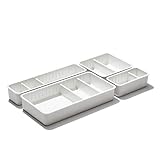
For the smaller stuff — drill bits, screws, hardware, the miscellaneous parts drawer every garage accumulates — a drawer organizer with no fixed slots works better than one with molded compartments, because your hardware collection never matches whatever the manufacturer guessed. And garages generate cord chaos fast: extension cords, a shop-vac cord, chargers for cordless tools. A ventilated cable box keeps that mess contained instead of turning into a tripping hazard next to the workbench.
Anchoring for safety: the step everyone skips
This is the part that gets left out when people talk about garage storage, and it's the part that actually matters most. A steel shelving unit's weight rating almost always assumes it's either anchored to a wall or loaded bottom-heavy enough that it can't tip. An unanchored unit, loaded top-heavy — which is exactly what happens when the lighter, less-used stuff ends up on top shelves — is genuinely capable of tipping over. That's a real hazard in a garage with kids, pets, or anyone who bumps into things while carrying groceries.
Anchoring a freestanding rack to studs with simple L-brackets takes maybe 20 minutes and turns a tip-over risk into a fixed structure. For overhead systems, the anchor point has to be a ceiling joist, not just the drywall or paneling — joists are usually 16 or 24 inches apart, and finding them accurately (rather than guessing) is the difference between a mount that holds and one that eventually pulls loose under load. A stud finder and good lighting go a long way here; garages are notoriously the worst-lit room in a house, and trying to locate a joist under a single bare bulb is how people end up drilling into the wrong spot.

What to skip: the units that bow, sag, and eventually fail
A few patterns show up over and over in garage storage that goes wrong. Skip resin or particleboard shelving units under $50 — the shelves themselves flex under moderate weight, and once they've bowed once, they never sit flat again. Skip adjustable wire shelving without shelf liners if you're storing anything smaller than a shoebox; items fall straight through the gaps and end up wedged in the unit's frame. Skip any freestanding rack you're not willing to anchor — if a product's own instructions mention anchoring to a wall and you're planning to skip that step, you should downgrade to a lighter load than the rating suggests. And skip storage bins that don't tell you their actual capacity; "large" and "extra large" on a label are not weight ratings, they're vibes.
The products worth buying are the ones that are specific and honest about what they hold — a stated pound rating, a stated fit, a stated seal. That's true of shelving and it's just as true of the smaller containers that end up on those shelves.

Frequently asked questions
What's a realistic weight rating for garage shelving?
For steel freestanding units, look for at least 800 lbs per shelf if you're storing bins, tools, or bulk supplies. For wire shelving, 350–800 lbs per shelf is typical, but small items fall through unless you add liners. For wall-mounted shelves, 30–50 lbs per shelf is normal and fine for tools and small bins — just don't expect them to hold what a steel rack holds.
Wall-mounted or freestanding — which should I choose?
Use wall-mounted for lighter, frequently-accessed items when floor space matters most. Use freestanding steel racks for your heaviest items — bulk supplies, holiday bins, power tool cases. Most well-organized garages use both rather than forcing everything onto one system.
Can I put heavy tools on overhead storage?
No. Overhead and ceiling-mounted storage is for lightweight, infrequently-used items like holiday decorations and off-season gear. Heavy tools, paint cans, and glass items shouldn't go overhead — the combination of gravity, an eight-foot drop, and something below it is not a risk worth taking to save floor space.
Do I really need to anchor my garage shelving?
Yes, especially for freestanding units taller than about 4 feet or any unit that gets loaded top-heavy. Anchoring to wall studs with basic L-brackets takes about 20 minutes and turns a genuine tip-over risk into a fixed, stable structure. Most manufacturer weight ratings assume the unit is anchored or loaded bottom-heavy.
How do I find studs or joists in a garage safely?
Use a stud finder rather than guessing, and make sure you have good lighting — garages are usually the worst-lit room in a house. Wall studs are typically 16 or 24 inches apart; ceiling joists follow the same spacing. For overhead systems, the anchor point must be a joist, never just drywall or paneling.
What's the biggest mistake people make with garage storage?
Buying one shelving unit and expecting it to hold everything — light tools, heavy bins, and seasonal gear all crammed onto the same shelves regardless of weight. The setups that actually last combine wall-mounted storage for daily-use items, freestanding steel for heavy loads, and overhead for lightweight seasonal stuff, each anchored appropriately for what it's holding.