Temperature control is the one thing cheap kettles skip that ruins coffee and tea. Boiling water (212F) is correct for black tea, French press, and cold brew concentrate. It is too hot for green tea (175F), white tea (160F), and pour-over coffee (200F). If your kettle has one setting and that setting is boiling, you are burning your green tea every time. A variable temperature kettle fixes this completely.
The kettle worth getting: Bonavita Variable Temp Gooseneck
The Bonavita is the recommendation that appears on every serious coffee forum, in every pour-over guide, and from every specialty coffee shop I have ever asked. It has five preset temperatures, a gooseneck spout that gives you control over pour rate and direction, and a keep-warm function that holds temperature for 30 minutes. At $75 it is the best value in this category by a significant margin.
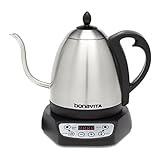
Why the gooseneck spout matters
A standard kettle pours in a rush — you cannot control flow rate, and uneven extraction is the result. A gooseneck spout lets you pour in a slow, controlled spiral that saturates the grounds evenly. This is why pour-over coffee from a gooseneck kettle tastes better than the same beans brewed with a standard kettle — you are actually extracting evenly instead of hoping the turbulence does the work.
What it pairs with
The Chemex and Aeropress are the two most natural companions for a gooseneck kettle. Both reward slow, controlled pours. The Chemex makes a clean, bright cup; the Aeropress is faster and more forgiving.


Temperature guide: stop guessing
White tea: 160-170F. Green tea: 170-185F. Oolong tea: 185-205F. Black tea and herbal: 212F (full boil). Pour-over coffee: 195-205F. French press: 200-205F. These are not fussy preferences — they are the temperatures at which these things taste the way they are supposed to taste.
What to skip
Kettles without temperature control if you make anything other than black tea or French press. The $30 option is fine for those two use cases. For everything else, variable temperature is the difference between your green tea tasting like grass and actually being enjoyable.
Kettles with a narrow temp range. Some budget variable-temp kettles offer 175F, 195F, and 212F. This covers most bases but misses white tea. The Bonavita hits 140F, 160F, 175F, 195F, and 212F — the full range.
Does water temperature actually make a difference in coffee?
Yes, measurably. Water below 195F under-extracts coffee — you get sour, thin, underdeveloped flavor. Water above 205F over-extracts — you get bitter, harsh notes. The window is tight and a variable-temp kettle is the only practical way to hit it consistently without a thermometer.
Is a gooseneck kettle necessary for pour-over?
Not strictly necessary, but it makes a significant difference. The gooseneck lets you control flow rate and pour pattern, which controls extraction. With a standard kettle, you are at the mercy of the pour angle. Most people who try both prefer the gooseneck because the cup quality is noticeably better with the same beans.
How long does the Bonavita kettle last?
Most reports are 3 to 6 years of daily use, with the heating element being the failure point. The build quality is solid for the price. Descale it every 3 months (white vinegar, run a full cycle, rinse twice) to maximize lifespan.
Is there a budget option with temperature control?
The Cosori Electric Gooseneck Kettle runs around $35-45 and has temperature control. It is not as precise as the Bonavita and the keep-warm function is shorter, but it covers the basics. For most home brewers it is a perfectly good starting point.
Can I use a regular electric kettle for pour-over if I also have a thermometer?
Yes — bring to boil, let it sit for 30 seconds to drop to around 205F, or 2 minutes for closer to 195F. A standard kitchen thermometer confirms the temperature. This works but requires more attention than a variable-temp kettle with a keep-warm function.