There is a version of a food book that is just a recipe collection with a narrative frame bolted on. This list is not about those. The books here are actually worth reading — some are memoirs, some are criticism, some are journalism, some are cultural history. What they share is that they changed the way I think about what I eat, where it comes from, and what eating actually means.
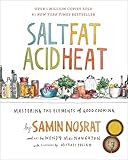
The essential starting point: Salt Fat Acid Heat
Samin Nosrat's debut is not a cookbook in the traditional sense. It is a theory of cooking. The argument is that four elements — salt, fat, acid, and heat — are the master variables behind every dish in every cuisine. Learn to understand those four levers and you do not need recipes anymore. You taste, you adjust, you cook. The writing is warm and specific without being precious. The illustrations by Wendy MacNaughton are genuinely beautiful.
The best food memoir ever written: Kitchen Confidential
Anthony Bourdain published Kitchen Confidential in 2000 and it still reads like a live wire. It is the behind-the-scenes account of professional kitchen life — the chaos, the camaraderie, the drug use, the burns, the obsession — written by someone who worked his way from dishwasher to executive chef and was honest about what that world actually looked like. What makes it more than a shocking memoir is the respect for craft that runs underneath all the chaos.
The better sequel: Medium Raw
Ten years after Kitchen Confidential, Bourdain wrote Medium Raw as a kind of reckoning. He was famous now, which he found complicated. The book is looser — more essayistic, more willing to sit with ambiguity — and in my view it is actually the better piece of writing. There is a chapter on the best meal he ever ate that is one of the finest pieces of food writing I have read.

The food critic you have never heard of: M.F.K. Fisher
Mary Frances Kennedy Fisher wrote about food before it was acceptable for serious writers to write about food, and she wrote about it better than almost anyone since. The Art of Eating collects five of her books into one volume that reads like a conversation with the most interesting, unsentimental person you have ever met. W.H. Auden said she was the greatest food writer in the language. He was not wrong.
The most important food book of the past 20 years: The Omnivore's Dilemma
Michael Pollan's 2006 investigation into what Americans eat and where it comes from is not comfortable reading. It is rigorous, journalistic, and does not let anyone off the hook. The structure is elegant: Pollan traces four meals from source to table — a McDonald's drive-through, an organic Whole Foods dinner, a pasture-raised farm meal, and a meal he hunted and gathered himself. The book changed food culture.
What you can skip — and why it matters
Not every beloved food book earns its reputation. Skip: celebrity chef memoirs from the past decade (mostly contractual obligations), "I moved to Tuscany" books (the genre is exhausted), and pop nutrition books disguised as food books (anything that promises to decode the relationship between one ingredient and your longevity is selling you something).
What is the difference between a food memoir and a food essay collection?
A food memoir uses food as the thread through a larger narrative about a person's life — Kitchen Confidential is a career memoir told through cooking. An essay collection is a writer returning repeatedly to food as a subject with a different argument each time — M.F.K. Fisher and Steingarten both work this way.
Do I need to care about cooking to enjoy these books?
No. Kitchen Confidential is really about labor, obsession, and identity. The Omnivore's Dilemma is really about American industrial capitalism. M.F.K. Fisher is really about desire and loneliness. Food is the lens, not the subject.
Is Salt Fat Acid Heat actually useful if I am an experienced cook?
Yes, because it is not a recipe book — it is a conceptual framework. Experienced cooks often report that it clarified things they were doing intuitively and gave them language to diagnose problems.
Are any of these books available as audiobooks?
Kitchen Confidential is excellent on audio — Bourdain reads it himself for the later editions. Medium Raw is also worth the audio version for the same reason. Salt Fat Acid Heat loses the illustrations on audio, so the print or ebook version is better.
What should I read after these?
If you love Bourdain, read Bill Buford's Heat. If Pollan is your entry point, try Dan Barber's The Third Plate. If M.F.K. Fisher is your person, Laurie Colwin's Home Cooking is a gentle and wonderful companion.
Is The Man Who Ate Everything hard to find?
The original edition is in and out of print. Used copies on Amazon are typically under $10 and in good condition. It is worth the search — the secondary market for this book is reliable because it has a devoted readership that keeps copies circulating.