The Bluetooth speaker market is weirdly bifurcated. Below $30 you get hollow, tinny plastic that sounds like a speakerphone. Above $300 you get audiophile territory that's overkill for a backyard or bathroom. The sweet spot — the place where you get genuinely good sound, real bass, a durable build, and useful battery life — lives between $50 and $100. That's the zone this article covers, and it's a great zone to be shopping in right now.
I've tested and tracked Bluetooth speakers obsessively for several years. The ones below are the ones I actually recommend when someone texts me asking which speaker to get for a camping trip, a dorm room, a gift for a teenager, or just an upgrade from the forgotten $20 thing in the bathroom. Here's what's actually worth your money.
The quick take: best overall picks
Before we get into use-case breakdowns, here are the three that earn top billing. The JBL Flip 7 (~$100) is the benchmark at this price — IP67-rated, genuinely full sound, 12-hour battery, and the brand recognition that means it won't confuse anyone you give it to as a gift. The Anker Soundcore Motion 300 (~$80) beats it on value: better bass response, stereo pairing, and smarter EQ for the money. The UE Wonderboom 4 (~$90) wins on portability and durability — it floats, it handles drops, and it sounds better than its puck shape suggests.
The right choice depends on what you're doing with it. Let's break that down.
Outdoor use: ruggedness and volume first
Outdoor speakers have one non-negotiable: they need to get loud enough to compete with ambient noise without distorting, and they need to survive the inevitable drop onto concrete or splash from a pool. IP67 is the rating you want — fully dustproof and waterproof up to 1 meter for 30 minutes. IP65 (water-resistant) is acceptable. Anything less is a liability around any body of water.
The JBL Flip 7 is the outdoor pick. It's been the standard recommendation for years because JBL keeps improving it without changing what worked: the cylindrical shape that projects 360-degree sound, the rugged fabric-wrapped exterior, and the battery that goes all day. At a cookout or a beach day, you want something with brand ubiquity — if the Bluetooth dies or someone needs to connect, everyone knows how a JBL works.
For a backup tracker on your outdoor gear (so you can find the speaker you left at the campsite), the Tile Mate is a $25 add-on that slips into any bag pocket and works with the Tile app — a genuinely useful companion purchase if you're the type to leave things places.
Desk and home office: clarity and stereo pairing
A desk speaker has different demands than an outdoor one. You don't need it to survive submersion. You need it to sound good at medium volume, ideally from 2–4 feet away, without fatiguing your ears over an 8-hour workday. Bass-heavy tuning that sounds great at a party becomes muddy and exhausting at a desk. What you want here is clarity and separation.
The Anker Soundcore Motion 300 is the desk pick. It has a dedicated tweeter and woofer configuration — unusual at this price — which produces actual high-frequency clarity that most Bluetooth speakers at $100 and below miss entirely. The BassUp technology is adjustable, which means you can dial back the low end when you're working and crank it for music sessions. Stereo pairing with a second unit (if you want to go that route) produces a genuinely wide soundstage for under $200 combined.
Shower and bathroom: waterproofing and suction
Shower speakers have one job: sound good while wet, mount easily, and not fall. The UE Wonderboom 4 nails this. It's IP67, it floats (so if it falls in the tub, it doesn't sink), and the 360° sound projection means it fills a bathroom from a corner shelf without you having to aim it. The loop on top makes it easy to hang from a showerhead or hook. Battery life is 14 hours, which means weekly charging at most.
One thing people get wrong: they buy a "shower speaker" with suction cups, and the suction cup fails within a month. Avoid any speaker that relies on a suction mount. The Wonderboom hangs or sits — much more reliable long-term.
Comparison table: JBL Flip 7 vs Anker Soundcore Motion 300 vs UE Wonderboom 4
Here's how the three main competitors stack up on the specs that actually matter:
| Feature | JBL Flip 7 | Anker Soundcore Motion 300 | UE Wonderboom 4 |
|---|---|---|---|
| Price | ~$100 | ~$80 | ~$90 |
| IP Rating | IP67 | IPX7 | IP67 |
| Battery Life | 12 hours | 13 hours | 14 hours |
| Stereo Pair | Yes (PartyBoost) | Yes | Yes (PartyUp) |
| Floats | No | No | Yes |
| Sound Profile | Balanced, mid-forward | Bass-forward, adjustable | Warm, 360° spread |
| Best For | Outdoors, gifting | Desk, home use | Shower, travel |
What to skip under $30 — and why
The sub-$30 speaker market is genuinely bad. Not "not as good" bad — actually bad. Here's what you're dealing with at that price point:
- Passive radiators that don't work. Cheap speakers claim bass from passive radiators (a membrane that vibrates to extend low frequencies). At this price, the passive radiator is an afterthought — you get a boomy, one-note low end that masks how thin the actual driver is.
- Bluetooth chips that drop connections. Budget manufacturers use older Bluetooth 4.x chips with limited range and unstable connections. You'll get dropouts at 10 feet. It's maddening.
- IP ratings that don't hold up. "IPX5 splash-resistant" on a $20 speaker often means the seals are adequate when brand new and degrade within a few months. I've seen too many of these fail after a single pool day.
- Batteries that degrade fast. Budget cells lose 20–30% capacity within the first year. A speaker that claims 10 hours new is running 6–7 hours by month eight.
If your budget is genuinely $30 or less, I'd rather you wait and save up to $50 where the Soundcore Mini series starts delivering real value. The leap from $25 to $55 in this category is dramatic. The leap from $55 to $100 is incremental.
IP ratings, battery life reality, and stereo pairing explained
IP ratings: what the numbers actually mean
IP stands for Ingress Protection. The two-digit code (IP67, IPX5, etc.) tells you: first digit = dust protection (0–6), second digit = water protection (0–9K). The "X" means "not tested." Here's the practical breakdown:
- IPX4: Splash-resistant from any direction. Fine for rain, not fine for a dunking.
- IPX5/IPX6: Resistant to water jets. Good for outdoor use and heavy rain.
- IPX7: Submersible to 1 meter for 30 minutes. Pool and lake safe.
- IP67: Dustproof + submersible to 1 meter. The one you want for beach and outdoor use.
- IP68: Dustproof + submersible beyond 1 meter. The premium standard.
Important caveat: IP ratings test new units under controlled conditions. Physical damage, wear to seals, and charging port exposure can compromise water resistance over time. Even IP67 speakers shouldn't live underwater.
Battery life: the reality gap
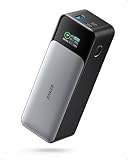
Manufacturers test battery life at 50–60% volume with no EQ adjustments and at room temperature. Real-world use — especially outdoor use where you're pushing volume to compete with ambient noise — cuts rated battery life by 20–35%. A speaker rated for 12 hours realistically gives you 8–9 hours at outdoor party volume on a warm day. Plan accordingly and keep a charging bank nearby for long days. The Anker 737 is overkill for this, but if you're also charging phones, it's the right call — 24,000mAh handles multiple speakers and phones across a full weekend.
Stereo pairing: when it's worth it and when it's not
Almost every mid-range Bluetooth speaker now supports pairing two units together in stereo mode. The pitch is compelling: buy two $80 speakers instead of one $160 speaker and get true left-right stereo. Here's the honest assessment:
Stereo pairing works well in fixed indoor setups where both speakers stay in place. It works poorly in outdoor scenarios because stereo separation breaks down when you move around or when the speakers are more than 8–10 feet apart. The sweet spot is a desktop or bookshelf setup where both units sit 3–6 feet apart at ear level. In that context, paired Soundcore Motion 300s at $160 total genuinely rival $400 dedicated desktop speaker setups. Outdoors, stick to a single large speaker rather than two small paired ones — the mono output from a JBL Flip 7 at full volume beats two paired smaller units every time.
Frequently asked questions
What's the best Bluetooth speaker under $100 right now?
The Anker Soundcore Motion 300 (~$80) for home and desk use, the JBL Flip 7 (~$100) for outdoor and gift scenarios, and the UE Wonderboom 4 (~$90) for shower and travel. All three are genuinely excellent — the choice is about use case, not quality ranking.
Is IP67 necessary for a pool-side or beach speaker?
IP67 is the minimum I'd recommend for any use near water. IPX5 and IPX6 handle rain and splashes but shouldn't be submerged. IP67 (fully dustproof + submersible to 1 meter for 30 minutes) covers pool, beach, lake, and boat use. Don't rely on IP ratings for extended submersion — they're rated for incidental dunking, not swimming.
How do I get better bass from a Bluetooth speaker?
Place the speaker near a wall or in a corner — the boundary reinforcement effect from nearby surfaces adds 3–6dB of perceived bass without any EQ change. Also, most companion apps (Soundcore, JBL Connect) have EQ presets; the 'Bass Boost' setting on mid-range speakers actually does something meaningful. What doesn't help: buying a speaker that's too small for the room and expecting bass — physics requires driver size and cabinet volume.
Are Bluetooth speakers under $30 worth buying?
Honestly, no. The quality cliff between $25 and $50 is steep. At $25, you're getting unreliable Bluetooth, weak battery cells, and drivers too small to produce real bass. At $50+, the Soundcore Mini series starts delivering genuine value. If the budget is hard-fixed at $30, wait and save — you'll regret the cheap one within a month.
Can I use a Bluetooth speaker in the shower every day?
Yes, with an IP67 or IPX7-rated speaker. The UE Wonderboom 4 is specifically designed for this use case and handles daily steam and splash exposure well. Keep the charging port covered or fully dry before charging — the port is the most common failure point on water-resistant speakers. One tip: hang the speaker rather than placing it on a ledge where it can fall. The Wonderboom's built-in loop is there for exactly this reason.
Does stereo Bluetooth pairing actually sound good?
In the right setup, yes. Two paired Anker Soundcore Motion 300 units on a desk 4–5 feet apart sounds significantly better than a single speaker at the same price. Outdoors or in a large room with lots of ambient noise, the advantage mostly disappears. The stereo pairing feature is most valuable for fixed home listening, not portable use.