Most kitchens have a drawer with a "sharpener" in it that hasn't actually sharpened anything since the Obama administration. It's usually one of two things: a cheap V-slot gadget that shreds the edge instead of refining it, or a honing steel that everyone mistakenly calls a sharpener even though it doesn't remove any metal at all. Neither is doing your knives any favors, and a dull knife is genuinely more dangerous than a sharp one — it slips off whatever you're cutting instead of biting into it. The good news is you don't need to spend real money to fix this. You need the right tool for your patience level, and you need to know the difference between the ones that work and the ones that just feel like they do.
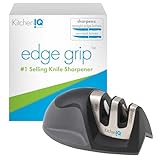
- Top pickKitchenIQ Edge Grip Knife Sharpener~$8
- Worth the splurgeChef'sChoice 4643 Diamond Hone Manual Knife Sharpener~$30
Pull-through sharpeners: the fastest, most idiot-proof fix
If you want the least amount of thinking involved, a pull-through sharpener is the answer. You drag the blade through a slot a few times, at a fixed angle the tool sets for you, and it's done. No skill required, no risk of rounding your edge into a mess, no ten-minute YouTube tutorial. The tradeoff is that pull-throughs remove more metal per use than a whetstone would for the same result, so your knife's lifespan shortens slightly over years of heavy use — but for most home cooks, that's a completely reasonable trade for a knife that's actually sharp tonight instead of theoretically sharp someday.
The KitchenIQ below is the one we keep coming back to. Cheap enough not to think twice about, two stages (coarse for a genuinely dull or nicked edge, fine for a quick touch-up), and the ceramic wheels in the fine slot won't wreck a good edge the way some ultra-cheap knockoffs do.
AccuSharp is the other classic in this category, and it's been the default budget pull-through for decades for a reason: fixed tungsten carbide blades instead of ceramic discs, so it works on knives that are genuinely neglected, not just slightly dull. It's more aggressive than the KitchenIQ, which makes it the better choice if your knife drawer has been ignored for a year or more.
If you like the no-skill simplicity but want a result closer to what a whetstone gets you, a diamond-coated three-stage pull-through is the step up. Same speed, same lack of skill required, it just refines the edge in more steps instead of one rough pass.
Electric sharpeners under $40: worth it or not
Electric sharpeners are pull-through logic with a motor doing the work instead of your arm. The honest answer: for a budget model under $40, you're paying for convenience and consistency, not a meaningfully better edge than a good manual pull-through gets you. They earn their keep if you're sharpening a whole knife block at once, or if hand or grip issues make the manual dragging motion uncomfortable. They're louder, they take counter space, and the cheap ones can be more aggressive on the blade than a manual tool because the motor doesn't know when to ease off — you do, whether you realize it or not.
Honing rods: the tool everyone confuses with a sharpener
Here's the confusion that costs people the most money: a honing rod (also called a sharpening steel, which is where the mix-up starts) does not sharpen a knife. It doesn't remove metal. It straightens a blade's edge, which bends and rolls microscopically every time you use it on a cutting board. A few strokes before you cook realigns that edge and makes the knife feel sharp again for a while — but eventually the edge actually dulls from wear, and no amount of honing brings that back. At that point you need an actual sharpener, one of the tools above. The habit worth building: hone before you cook, sharpen every few months.
Whetstones: the real skill, and why it's worth learning anyway
A whetstone is the only tool here that actually improves your knife's edge geometry instead of wearing a fixed angle into it repeatedly. It's also the only one with a real learning curve — holding the knife at a consistent angle (usually 15–20 degrees) and dragging it across a flat stone by hand takes a few tries before it feels natural. The payoff is a sharper, longer-lasting edge and a knife that keeps its shape better over years, because you're controlling exactly how much metal comes off instead of letting a fixed slot decide.
A combination stone with two grits in one block — coarse for repair, fine for polishing — is the budget-friendly way in. You don't need a $150 Japanese water stone setup to get real results; a $28 combo stone and 20 minutes of YouTube gets you most of the way to a genuinely professional edge.
How often you actually need to sharpen (and what to skip)
For a knife used daily — chopping vegetables, breaking down chicken, the normal home-cooking rotation — hone once a week and run it through a pull-through or whetstone every 2–3 months. Cutting mostly soft food a few times a week? Stretch that to every 4–6 months. The tomato test is the honest signal, not a calendar: if the knife squashes the skin instead of slicing cleanly through on the first pass, you waited too long. Sharpening early doesn't hurt anything — waiting until it's genuinely dull just means more metal has to come off to fix it, which is the real reason over-sharpening shortens a knife's life, not the frequency itself.
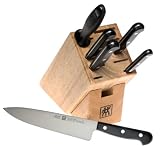
A few things not worth your money: any sharpener with no stated grit or abrasive material listed (usually a flimsy stamped-metal V-slot that chips edges rather than refining them); the built-in sharpener slot on some knife blocks, which sits at a fixed, often too-steep angle and grinds your edge down a little every time you re-insert the knife; electric sharpeners under $15, where the motor is typically too aggressive and inconsistent; and "sharpens anything" combo tools that claim to handle knives, scissors, and garden shears in the same slot — a slot built to be universal is a slot built to do nothing particularly well.
If you own exactly one sharpener, make it the KitchenIQ. If your knives have gone a year or more without attention, start with the AccuSharp instead. If you already own a pour-over kettle and a grinder that weighs beans to the tenth of a gram, skip straight to the whetstone — you'll enjoy the process as much as the result. Everyone else is well served by adding a honing rod to whichever sharpener they pick, since honing between sharpenings is what stretches the gap to every few months instead of every few weeks.
Frequently asked questions
What's the actual difference between honing and sharpening?
Honing realigns a blade's edge without removing metal — it's maintenance, done often, with a rod. Sharpening removes a small amount of metal to create a new, sharp edge — it's the actual fix, done every few months, with a pull-through, electric sharpener, or whetstone. A honing rod alone will never fix a genuinely dull knife.
Is an $8 pull-through sharpener really as good as a $30 one?
For pure sharpness, they get you closer than you'd expect — both use a fixed angle to grind a new edge quickly. The more expensive diamond-hone models add extra polishing stages that leave a slightly cleaner, more refined edge and tend to be gentler on the blade over hundreds of uses. For most home cooks, the $8 KitchenIQ is genuinely enough.
Do electric knife sharpeners damage knives?
Cheap ones (under $15) can, because the motor doesn't ease off the way your hand naturally does with a manual pull-through, and it removes metal faster than necessary. A decent $25–30 electric sharpener with distinct sharpening and honing stages is safe for regular use.
How do I know if I should use a whetstone instead of a pull-through?
If you're willing to spend 15–20 minutes learning a consistent hand angle and want the sharpest, longest-lasting edge possible, a whetstone is worth it. If you want your knife sharp in under a minute with zero learning curve, a pull-through is the better fit. Plenty of people own both.
Can I sharpen serrated knives with these tools?
Pull-through and electric sharpeners generally can't sharpen serrated edges — the fixed slot is built for a straight edge and skips over the scalloped teeth. Serrated knives need a specific tapered sharpening rod that fits into each scallop, or professional sharpening.
How long does a budget sharpener actually last?
A pull-through with ceramic or carbide slots (KitchenIQ, AccuSharp) lasts for years of regular home use. A whetstone lasts even longer since it's just a block of abrasive material with no moving parts, though it gradually wears down and may need occasional flattening.
Is it bad to sharpen a knife too often?
Sharpening removes a small amount of metal every time, so doing it far more often than needed will shorten a knife's usable life over many years. In practice this is rarely the real problem — most home cooks sharpen too rarely, not too often.