Most people buy an air purifier after an event: a wildfire smoke week, a new cat, a baby on the way, a respiratory doctor suggesting it. The impulse is right but the follow-through is usually wrong — they pick something that looks good on a shelf photo, plug it in, and forget about it until the filter light turns red six months later. This list is for making the right call the first time: real HEPA filtration, right-sized for a small apartment, quiet enough to sleep through, and honest about what it actually costs to run.
True HEPA vs. HEPA-type: the distinction that matters
True HEPA is a specific standard: a filter that captures 99.97% of particles 0.3 microns and larger. Pet dander, dust mite debris, mold spores, fine particulate from wildfire smoke — a True HEPA filter catches all of it. HEPA-type, HEPA-like, and HEPA-style are marketing terms with no regulatory meaning. They typically capture 85–95% of particles — better than nothing, but meaningfully worse when air quality actually matters. Every pick in this article uses a genuine True HEPA filter.
Also: activated carbon pre-filters handle odors and VOCs (cooking smells, off-gassing furniture, pet odor, smoke smell). A True HEPA filter alone doesn't absorb gases — you need both. All the units below include activated carbon alongside the HEPA.
CADR explained: the only number worth comparing
CADR stands for Clean Air Delivery Rate — cubic feet per minute of filtered air, tested independently by AHAM. Higher CADR = more air cleaned per minute. The rule of thumb: your CADR (smoke) should be at least two-thirds of the room's square footage. A 200 sq ft bedroom needs a CADR of at least 130. Most picks below are CADR 140–260, which is the right range for small apartments.
Sizing for small spaces
You do not need a whole-home purifier for a studio apartment. One well-placed unit sized to the room where you spend the most time — usually the bedroom — does more good than a giant unit running intermittently in the living room. Place the unit on the floor with nothing blocking the intake. Units pushed into corners can lose 20–30% of their effective CADR.
The ranked picks


Filter replacement costs: the real price of ownership
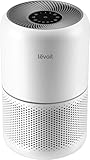
- Levoit Core 300: ~$20 filter, replace every 6–8 months = ~$30–40/year
- Coway AP-1512HH: ~$25 filter, replace every 6–12 months = ~$25–50/year
- Winix 5500-2: True HEPA filter ~$30, but the pre-filter is washable. Total ~$30–35/year
- Blueair Blue Pure 411: ~$30 filter, 6-month life = ~$60/year — highest ongoing cost in this group
What to skip
Ionic/ionizer-only units don't capture particles — they charge them so they stick to walls. You're moving the dust, not cleaning the air. Some also produce ozone as a byproduct. Ozone generators actively produce ozone to "sanitize" the air — the EPA is direct about this being harmful. HEPA-type units under $50 — the "HEPA-type" label means nothing. Spend $80–100 for a genuine True HEPA unit.
Do air purifiers actually do anything for allergies?
Yes, meaningfully. Airborne allergens — pet dander, dust mite debris, pollen, mold spores — are all in the particle size range that True HEPA filters capture. Running a purifier in your bedroom continuously reduces overnight allergen exposure. Most allergy sufferers notice real improvement within a few weeks.
How often should I actually replace the filter?
Manufacturer guidance is typically 6–8 months at normal use. If you have pets, live in a wildfire-prone area, or run the unit 24/7, replace closer to 6 months. The filter indicator lights on the Coway and Winix are hour-based timers, not actual air quality sensors — if you can see visible gray discoloration on the white HEPA media, replace it regardless.
Should I run it 24/7 or only when I'm home?
24/7 on a low speed is meaningfully better. Air quality drops quickly when a purifier is off. The electricity cost of running a 20–30 watt unit continuously is roughly $2–4/month. Set auto-mode units to auto and forget them.
Does one purifier cover an entire apartment?
In a studio or one-bedroom with open floor plan, a mid-size unit (Coway, Winix, Levoit 400S) can handle the whole space on medium. In a two-bedroom with separate closed rooms, you'd need two units. Prioritize the bedroom.
What's the difference between the Levoit Core 300 and Core 300S?
The Core 300S adds an air quality sensor, auto mode, and VeSync app connectivity. The base Core 300 is manual. If you want set-it-and-forget-it with automatic response to cooking smoke, the 300S is worth the ~$30 premium.
Can an air purifier help with wildfire smoke?
Yes — this is where True HEPA filtration is most clearly effective. The fine particulate matter in wildfire smoke is exactly in the 0.3–2.5 micron range HEPA filters capture. During a smoke event, run on medium-high, keep windows closed, and place in the room where you spend the most time.